Week three of the first ATPL module began on Monday morning bright and early, as usual at 8am. Another class test (AGK) was quickly completed followed by one covering Instruments. The tests included mostly material from the previous week but also that from week one, helping to slowly build up the knowledge.
Today we completed the Principles of Flight test which, not knowing the score, I feel went quite well. In between these tests we have indeed been in the classroom for the entire two days covering new material.
This afternoon we reached the halfway point of the five weeks of ground school of the first module. In two and half weeks time we will have only four days to prepare for the Consolidation exams (mocks). Although only just over two weeks in it really has gone very quickly and the next fourteen weeks leading up the going home for Christmas I am sure will pass just as fast.
Sunday afternoon. Flightline, Melbourne International Airport, Florida.
I for one am neither a fan or regular of afternoon flying; being able to count the number of times I've been up in my little Warrior on one hand.
Sunday's general aviation flying in the mid-drift of Florida is quiet. It's a surreal feeling being one of only a small percentage of the students that regularly fly from KMLB actually in the Flightline. Adding to the fact it was indeed an afternoon and I truly felt outside of my comfort zone.
The weather was looking very good with a bit of precipitation further south of where we were heading. In fact the weather has been superb ever since Sunday.
After an extremely long taxi down to Runway 9R we departed to the south west into the practice area. It was the first time I'd flown in three weeks with the start of ground school and instructor availability both playing parts.
It was mainly a refresher flight to get back into the swing of flying the aircraft and fine tuning before the FAA PPL which I'll hopefully complete by the end of this month.
Two hours later we descended back into the Class D airspace and shortly after we were back in the Flightline.
The debrief complete swiftly, both my instructor and myself very happy and then onto the bus for the fifteen minute journey back to the apartments.
I was messing with my flight documents in my bag and as I finished I looked out of the left hand window just before we set off. The American flag I've seen almost everyday while I've been here has always flown high above the car park at FIT Aviation. Sunday it sat at half mast. It was at that point I realised I had indeed completely forgot about such an important day in America's and indeed the world's history.
I had just completed a full flight in US airspace without the first thought of what happened those ten years ago. Maybe that's the way it should be...
Yesterday brought the end to the written examinations, in fact, any ground school for around 2 months. Tuesday morning, around about 7am I took the exam for the FAA PPL. It basically consisted of going into a small room with table, chair and computer to complete the task. The room is also monitored via camera.
The actual exam consisted of 60, three answer multiple choice questions which would be answered on the computer. Imagine the UK driving license exam - something along those lines. The time given for the paper is 3 hours however I wasn't planning to be in there, as wouldn't most, for more than 30 minutes to an hour. The pass rate on the exam is 70% (42 correct answers).
In preparation for the exam we are given what is called the 'Gleim book' which consists of every possible question that could come up on the test - word for word. Now whether ethical or not it is very evident that the aim of the game is to remember as many questions, and more importantly answers, as is feasibly possible. Although this was the case a significant number were answerable by knowledge we had learnt from the far more in depth JAA material.
So, exam finished and passed by 7.30am (85%) it was time to head back home. That was it. No more serious study for nearly two months. Flying and resting is now the aim of the game. Although having said that this week I have and will continue to get up between 5am and 5.30am every day which isn't the greatest although around take off point at 7.15am I fully appreciate the early morning rise from slumber.
Following the exam it was time to celebrate and after a small unsuccessful bike ride to the Irish bar in down town Melbourne we headed for breakfast on campus. The rest of the day was spent relaxing by the pool and a quick visit to the gym.
In the air the flying is going well. I've now got 5.3 hours in my log book and already booked in twice for tomorrow and another trip the following day which is fantastic.
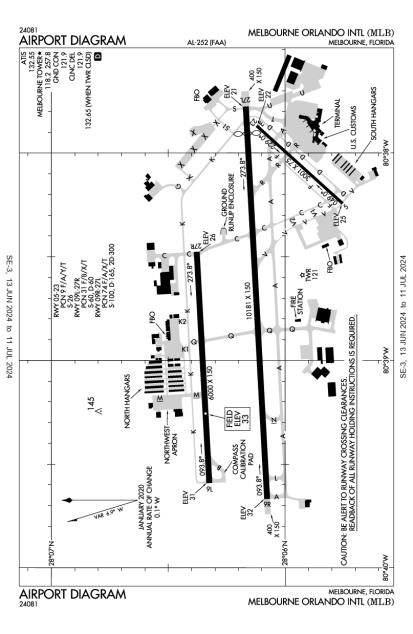
Melbourne airport consists of two parallel runways plus one crossing runway. In total there is 27L/9R (longest runway), 27R/9L (2nd longest) and runway 23/5 (obviously the shortest). The runways are named by their magnetic heading to the nearest 10 degrees. So basically if a runway had a magnetic heading of 312 degrees the runway 'name' would be Runway 31. If two runways run parallel to each other as is the case here in Melbourne and at many airports across the world (in the UK we have Heathrow and Manchester as the predominant airports with such a set up) then they will be suffixed with left (L), centre (C) or right (R) as required. The main runways that we use as our particular flying school are 27L/9R and 23/5. The other is mainly used for circuits. Scheduled airlines such as Delta and US Airways use the main runway 27L/9R for obvious reasons.
Below is a bit of an indication as to how the airport is set out both as a map and picture.
After completing my flight early Monday morning a colleague was due to fly a cross country solo to Fort Lauderdale further down the Florida coast. He asked if I would like to tag along - the answer obviously being yes!
The flight was to consist of after departure following a direct route down to Fort Lauderdale International airport to complete a touch and go and then to return to Melbourne followed by a serious of touch and go's. The flight time in each direction would be little over an hour with a cruising altitude between 2,500ft and 5,500ft. During this flight I would simply be observing everything and taking no part in the operation of the flight.
After departure we immediately headed southbound directly towards our destination. The aircraft, the same type as the airplane I am currently training in, does climb quite well and will do so most effectively with an airspeed of 79 knots (approximately 91mph). The cruise speed very much varies due to winds etc. but can be expected anywhere between 100-120 knots (115-138mph) for an average journey. We reached our cruising altitude in little time and the pilot in command (PIC) set about completing the relevant checks and procedures to maintain a safe and law abiding flight.
Being able to take advantage of just sitting and observing was fantastic. I was able to ask questions when needed and gained massive experience for future training. The most interesting and beneficial area of the whole trip was being able to listen to the interactions between ATC and aircraft. Currently I'm starting to use the communication tools more and more and this was great for both current and future reference.
As we approached the outskirts of Fort Lauderdale airspace it became apparent that the weather was advancing much more rapidly than anticipated therefore the PIC made the call to cancel the current flight plan and immediately return to base where the weather would be much more favourable. Again, more experience on how to judge the meteorological conditions from someone who has much more experience than myself in flying an aeroplane.
On route back to Melbourne we approached Palm Bay, another busy scheduled airport about half way between both departure and arrival fields. It is served by a significant number of the larger american airlines therefore activity in and out of the airport is fast and heavy. Due to our course heading directly over the main arrival routing into Palm Bay we were instructed by ATC to head directly over the field to avoid any other traffic. Below are a couple of pictures over Palm Bay International airport.
Unfortunately as we were heading straight across I was unable to get any good views of the actual airport and therefore pictures were kept to a minimum.
Following this the PIC decided to continue to follow the new path back north and what a great decision that turned out to be. Following the coast line not only brought some amazing views but the weather was far superior to that further inland which made of a very smooth and comfortable ride home.
As you can see the views made up for any lack of in flight entertainment. As mentioned, the air was smooth for the cruise and we soon approached Melbourne. Decent and approach were dealt with quickly and efficiently and it was now time for the PIC to complete a number of 'touch and go's'.
'Touch and Go's' are basically landings and instead of then stopping the aircraft, while still rolling down the runway, is configured to take-off conditions before returning back into the sky. The aircraft will then climb as it would on any other take-off before continuing on the circuit to complete another run. The PIC completed five of these before returning to the airport ramp. Below is a video of the final landing on runway 5.
All in all a fantastic experience which I hope to replicate many times over the coming months. It really does drive home how lucky I am to be here and the adventure that is still only just starting.