Showing posts with label Melbourne. Show all posts

Thursday, 5 July 2012

Pilot Training College comes to an end as we know it


What a weekend. I honestly don't know what to say. For those of you who are unaware, PTC yesterday went into what examiner-ship (a restructuring process). Their assets were handed over to an independent body and stripped by the IAA of their right to train in the interim.


Late last week we heard from the states that the Florida operation had been grounded by the the subcontractor, Florida Institute of Technology. This has happened once before when we were in the USA and again shortly after we returned.


Thinking it was a similar contractual problem we treated it as we had the previous two occasions. However, shortly afterwards a meeting was called for all students and staff in the USA. It was at that point that the Floridian based student body were told that the US operation had gone into administration and that they should try to contact those in Waterford for answers.


With today's technology the news soon spread over to this side of the pond and it was at that point we worried about our own futures with the company here in Ireland.


We were all told that operations were to continue as normal in Europe. Had it not been for the bad weather over the past couple of weeks I may not be sat here with this been a direct concern of mine.


However, yesterday morning we were told, while waiting to go flying, that training operations were being grounded until the afternoon. We were not told the reason immediately for this.


Later in the day the information was made available to us that the IAA had suspended the authorisation for the Pilot Training College to train any student in the United States or Ireland. With this news it meant we wouldn't be able to complete any ground school, simulator or flight training.


It wasn't until this morning when we were called to a student meeting where we were told that unfortunately due to the situation no student would be able to complete their training with the organisation and that each would have to speak to the IAA about their training and what they need to do to progress further with their training.


Over the past few days the airline along with certain companies and authorities have been able to make swift arrangements to reorganise the training for the four of us and keep alive the goal of making the type rating start date of the 30th July.


We're now here in Dublin waiting to begin our MCC/JOC stage of the training which was originally designed to be the final step before receiving our licenses. In this unique situation following the ten days here we will head to Cork to another flight school who will complete our Instrument Rating. I will be sure to explain what all this means in the coming days.


Going back to what has happened over the past few days it is a travesty that such a fantastic group of employees, both as instructors and other roles within the company at both bases have been put in such unfortunate circumstances.


It's no secret that PTC gets it's fair share of critics but throughout my training, as you will have seen on here, the quality of instruction has been absolutely superb. The people involved in creating the dream of being a commercial airline pilot are fantastic at what they do. 


I'm extremely proud to have worked with some of the most interesting, most intelligent and kindest people I have ever had the pleasure of meeting. 


We are in an extremely fortunate position and I cannot even think about coming to terms with what those in the United States are currently going through. It's great testament to them all who are actively and positively making moves to deal with their own futures.


The news has obviously made national press here in Ireland and today in the Irish Independent printed a double page spread. Something that stood out for me:


"The trainee pilots get to sample a slice of the famed American college life. The bunch I met lived on campus, mixed with other students and enjoyed the kudos that came with walking around in a pilot's uniform.


"There were other perks too. When I was there we did a 'fly over' to Nassau in the Bahamas, where the students got their first taste if international flying as our fleet of about 10 planes crossed from the US.


"Private airports, swimming with pigs, and a visit to the stunning Atlantis resort were just some of the highlights of an unforgettable weekend that would have seemed even more spectacular to a gang of teenagers.


"My overwhelming memory of their Florida experience, though, isn't any of that. It's the print-outs of a cockpit interior that were pinned up all over the walls of one of the apartments I visited.


"This was Florida, there was a whole world outside the dorm-room door, but they were all there to work."


Saturday, 2 June 2012

Home for the weekend


It's been a couple of weeks since I've updated the blog. I've actually managed to get quite a bit in! I've been up for the first time into the air in Waterford, completed a number of simulator sessions and returned to the UK for a great weekend enjoying the early summer.


The simulator is progressing slowly, a little slower than planned or wanted but all the same it's moving. I've now completed thirteen simulator sessions with another seven to go. In the past fourteen days or so we have progressed from the basics to working with single engine and more in depth and demanding approaches. It's also great to see the instructors adding in certain tricks. Last night being a prime example.

An ILS approach is something that is the norm for most major and smaller airports across the glove. It stands for 'Instrument Landing System' and is designed for the final approach to landing by giving a vertical and horizontal approach path. The system is quite basic in design but in today's larger more advanced aircraft it can be used to put the plane on the ground in zero visibility and bring it almost to a stop on the runway, all with the use of computers.

Unfortunately for us our aircraft aren't capable of doing that and neither will our licenses be when we leave here from PTC. We are however trained to fly, solely by the use of the instruments, to follow the ILS down to 200ft above the aerodrome. Having yet to experience it in a real situation, the simulator can create something like what we can expect in the air. It is quite an amazing sight and satisfying feeling to pop out of the clouds only 200ft above the surface with lights glaring at you from the terrain.

Anyway, I digress. We were situated at Blackpool airport in the 'sim', a local airport in the UK where in the real world a small number of airlines use. We departed and headed towards the larger and more well known Manchester airport just 40 miles away. On approach we were giving our approach procedure. We were told to fly over the airfield and track a radial (track over the ground - I'll explain in a future post) to a certain distance from the airport. We would then make a series of turns to in effect make a 180 degree change of direction to follow the approach path to Manchester Airport runway 23R.

To follow the ILS we need to insert a frequency into the aircraft computers which in turn create the vertical and horizontal profiles on our dials in front of us. Frequencies obtained and entered in to the system we began the final approach. 


To confirm that we indeed have the correct signal we are required to 'ident.' This will give us a Morse Code to confirm we are receiving the correct signal from the correct station. They're usually identifiable by three letters. Manchester, being quite a large airport, has more than one ILS station (in fact it has three!) so there is the chance (well, in the simulator there is...) of there being an incorrect signal being received from a different runway which uses that same frequency.

It's all very complicated I know but the general gist of the story is that we had not correctly identified the signal and therefore were following a signal desired for the other end of the runway. Our confusion intensified as we continued on our intercepting heading for a far greater time than would be required. 


If this were to happen in real life and we did indeed overshoot and end up somewhere we really weren't supposed to be, especially in such busy airspace as the north west of England (I dread to even think about the south east near London!) then it could all get just a little bit messy...

Obviously the likelihood of this happening in real life is slim to none with the safety factors put in to such equipment and the procedures in place to make sure that only the correct signals are being sent on the correct frequencies. However, having experienced it in a simulator, it's certainly not something I plan to experience in real life any time soon!


Alongside the simulator I have also managed to jump in the back of one flight around the local area here in Waterford. The weather after arriving hadn't been spectacular but this particular afternoon the weatherman was on our side and I headed up in to the Irish sky for the first time. 

It was such a change from what we have experienced over in the US. First and foremost the radio telephony is far more strict and advanced here in Europe and the there was no doubt from the tower of what he wanted us to do that afternoon. It's very impressive to hear the crisp, professional and efficient radio calls being used. It's something I think I am going to like.

Anyway, we headed out to the south Irish sea and performed a number of approaches in to Waterford. It's great to actually see them being performed in the aircraft as opposed to just in the simulator - it's also seems much easier as well! The flight was quite short at just over ninety minutes and soon enough we were back down on the ground.


The whole operation with regards to the flying stage over here is a complete contrast from that in Melbourne, Florida. 

With over forty aircraft, state of the art ground facilities and hundreds of students, the FIT facilities at Melbourne International; as I have referred to before, are some of the best you can experience anywhere in the world. The size of the operation makes everything much more affordable and accommodating.

Here in Waterford, where the operation is on a much smaller scale the facilities are there to mirror that. For example, in the States the majority of aircraft parking spots were 'drive through' style where one could park and then the following student simply taxi the aircraft forward and back onto an active taxiway. This worked very well and meant there was no need to push the aircraft. 

Here the process is a little different. The aircraft is parked near the hangars and pointed in the direction easiest for the re-fueler. It is then the duty of the instructor and student to push the aircraft back in to a suitable position for start up and taxi.

All in all the flying when airbourne is very similar. I'm not saying the facilities here are any worse than those in Florida, just that they shouldn't be compared for obvious reasons.


In the simulator last week, both myself and my simulator partner were unfortunate enough to have three sessions cancelled between us due to the simulator having technical faults - we still say that it wasn't our faults! This was something that was quite frustrating but obviously there is nothing we could do! 

Fortunately, after the final cancellation I was able to jump on a plane from Dublin back to the UK for the weekend. It was great to get home and enjoy the fantastic weather that we seemed to be missing down here in the south east of the Republic. 

Having enjoyed the great weather at home hopped back over the Irish Sea early Monday morning to head straight back in to the simulator in the afternoon. Upon our arrival back here we were told the weather hadn't much improved and they had only had one day of sunshine - this made the trip home sound even more rewarding!


The arrival of the remainder of our class two weeks ago from the US has added a little bit more life in to the place with the downside now being that there are a lot more students to use the facilities here. We have received our schedules for the up coming two weeks and thankfully we should be getting a significant number of 'events' but there is still a lot of downtime to play with. 

With a completion date now set to be at the start of July here in Waterford we'll head up to Dublin for a week to complete our MCC/JOC in the larger, more sophisticated simulators. This will realistically leave us with about two weeks before starting the the Type Rating in England.

This will be a very short space of time to sort out housing and transport etc (I love car shopping!) but we are some of the very fortunate so it's something we're just going to have to put up with...


Saturday, 21 April 2012

United States - Complete


JAA Ground School                                         -     Complete
FAA Ground School                                         -     Complete
FAA PPL written exam                                    -     Complete
JAA PPL internal check ride                           -     Complete
FAA PPL check ride                                        -     Complete
14 JAA ATPL examinations                            -     Complete
JAA CPL qualifier internal check ride            -     Complete
JAA MEP/CPL check ride                               -     Complete

As trainee pilots we all learn the task of reading from checklists very early on in our training. They're our best friend. They detail everything we should be doing to make sure that the systems there to operate a safe flight are configured correctly at each respective stage of flight.

Over the past eleven months or so we have been working through that checklist of requirements we need outlined by both the training college and the national authorities. As you can see from above there have been quite a few and as I sit here, 35,000ft above the Atlantic ocean I'm ecstatic to say the final hurdle on the American adventure has been completed.

It's been about ten days since I've updated this page and this has solely been due to the amount of flying and ground study I have had to do to get out of Melbourne in time for the start of the next part of training on Monday morning.

I completed the flying programme on Monday evening and on Tuesday lunchtime I took to the air with the Chief Flight Instructor for my mock check ride. The flight went really well and he was happy to put me forward for the IAA exam the following day.


Preparing for the final flight in US airspace as well as preparing for a much larger flight later that evening if everything went to plan was extremely time consuming! The time passed over to 2am before my head hit the pillow. I was getting up on two hours and forty-five minutes later for the biggest test of the training so far.

4:45am. The alarm sounds. The last time my head would touch a pillow for over thirty six hours. Flight bag ready, the journey to the Flightline was as it ever was at this time in the morning. Very quiet and solemn. The fifteen minutes passed pretty quickly as I went through the emergency procedures which should be learnt to memory one last time.

Arriving early enough to complete the paperwork before the flight 7:30am soon came around and it was time to meet up with the examiner for a pre-flight briefing. He ran through everything very quickly and summarized the briefing we had had a couple of days earlier. Both happy we headed out to the plane.

The flight consists of around 2.5 hours in the air covering everything from a navigation route, flying solely on the instruments, dealing with unusual attitudes, system failures, emergency situations (engine fire, engine failures) and work in the pattern. 

It all went swimmingly (apart from a scary moment where I thought I'd lost me my during the navigation diversion!) and on parking at the ramp I was congratulated by the examiner on passing the flight. 


Over the moon I headed back into the Flightline to immediately book my flight back to the UK. With all the excitement the serious lack of sleep and thumping fatigue seemed to sit at the back of my mind bothering much less than it had at sunrise.

I now had a deadline where the car would be picking me up to take me one last time to Orlando International airport. Work to be done. Checking out of the United States was easier than expected. As with everything there is a serious amount of paperwork, most of it pompous and unnecessary but no less it was all complete, signed and delivered to the relevant persons.

Now was the hardest part. Saying goodbye to everyone. 


In the past eleven months I have had the great honour of meeting some of the most interesting, some of the kindest and most certainly some of the most talented people I could possibly wish to come into contact with. From school leavers and university graduates to those who have worked in the depths of central London. From professional sportsmen to photographers. Whatever the career path was, it was quite clear to see that everyone out in Florida is there to achieve that one goal and dream of becoming a commercial airline pilot. 

I do wish everyone still out in the US the greatest of success in the future and hopefully I'll see a number of them either in Ireland next month or in the air during the future!


With the goodbyes dealt with both in person and via email I was quickly descending on Orlando International airport. 

With the amount of luggage I was taking home I was pretty embarrassed when I saw the weight of the luggage as it was totaled up by the Virgin check-in staff. The kind lady smiled at me, gave me my extra legroom ticket and said "enjoy your flight." I can get used to these extra perks!

Through security and duty free and it was time to wait for the flight home. It was the first time since I had passed the flight test taken earlier in the day I realised what was going on around me. The rush of preparing for home blurred everything else and it hit me. 

"I'm a multi-engine commercial pilot." 

Looking out at the Boeing 747 affectionately named "Pretty Woman" by the airline that was due to carry me seven hours to the east very shortly; the perfect setting. 


The time I have spent in America will forever be remembered.

Seeing the sun rise over the Atlantic ocean from 8,000ft for the first time; visiting Miami and it's world famous beach; flying in to some of the US's biggest airports in one of the smallest planes on the market; being part of a world leading programme on hypoxia training and undertaking upset recovery training are just some of the highlights of an amazing eleven months.


So...what now? Well having been at home for a couple of days and catching up with some friends and family I'm back at the airport again tomorrow to catch a short flight over the Irish sea to Waterford. The Instrument Rating (IR) course begins on Monday morning and will take around six to eight weeks to complete.

It's time to continue packing for the next stage of training, maybe a few less pairs of shorts this time...

Tuesday, 10 April 2012

Twin flying


The past week has been pretty intense. Coming to terms with a new aircraft in such a short space of time is quite challenging.

Since the last update I now sit with seven flights remaining, five with my instructor, one mock check ride and then the real thing, hopefully next week at some point.

The thirteen flights in which we take to the air in the Seminole are designed as followed.

The first four are called MEP flights including an internal check ride on the fourth. The 'MEP' stands for Multi-Engine Pilot rating. It mainly consists of flying the aeroplane and understanding how it works. What to do when an engine fails, what to do with an engine fire, flying with only one engine (asymmetric) and coming to terms with a different type of power-plant (not to mention there being two of them!)

It has been a steep learning curve and I hope I'm more settled in the aircraft moving forward over the remainder of the course. My instructor is the Chief Pilot here at the flight school and he is notorious for expecting extremely high standards from the moment you arrive to the moment you leave the Flightline and I think this will certainly put myself and his other students in good stead not only for the check ride but for future flying.


The second stage of the training in which I am currently completing is advancing on that already set in stone in the single engine aircraft - the Piper Warrior. The Commercial Pilot's License (CPL) will allow the holder to fly for reward which is certainly something we shall need when sat in the right hand seat of a large passenger aircraft when we're expecting a pay cheque at the end of the month!

This involves a lot of 'under the hood' instrument work and planning navigation's to grass strips quite literally in the middle of nowhere. I've completed one of each and although there is an increase in workload it is easy to appreciate the similarity between both aircraft. Hopefully I'll be able to build on the feedback from my instructor over the coming days.


So...with less than two weeks until I'm due to report in Waterford for the beginning of the next stage of training there is so much to do I wouldn't know where to start.


Although Melbourne, Florida doesn't have the excitement of Miami South Beach or the thrills of Orlando's theme parks; spending ten months in one place does bring it's affections (however small they may be) and in compliance with Newton's third law grievances which will most certainly not be missed! 

The state of Florida, as I've said in previous posts, is the world leader, without a shadow of a doubt, of the best pilot training facilities (both man made and natural) there is on offer not only in the United States but across the world. Global gateways accepting small aircraft travelling at barely half the speed of those around them being an everyday occurance for those talented enough to be sat two hundred feet in the air overlooking the fields from the control towers. Their common courtesy and professionalism knowing no bounds.

Closer to base at the Florida Institute of Technology where one of the busiest and most well run flight schools is operated. It is something that we in the UK especially can only dream of. The money invested and the options available to anyone who wants to learn to fly are truly world class.

I don't want to get too sentimental just yet as there is a lot of work to be done before I can turn my back on this small city on the eastern coast of the sunshine state.

Seven more flights, packing, checking out of the university and then preparing for the next stage of training lie ahead over the coming ten days or so.

There will be time to reminisce over the past ten and a half months during the journey home. And with what I have planned ahead before the end of the year there will be little time to continue living in the past when those wheels touch down on UK soil.

With my journey in the aviation world moving fast so too are those of my two previous instructors, both who are currently enjoying great success in their new jobs. I hope both continue to prosper and I thoroughly look forward to seeing where they end up in a few years time!

Exciting times lay ahead both with PTC and my future employer.However, the sun still has to set over the horizon in Melbourne first...


Sunday, 1 April 2012

Knocking down the hours...Part II


Firstly, sorry for the long time between updates - I've been extremely busy this past week or so!

I know sit here writing having completed all of my single engine hours. Tuesday was the final day of making up time I was short.

Over the past week I have done so much with my flying it has been great and it is sad to see the end to the work horse that is the Piper Warrior. The thousands of miles I've taken inside the cockpit of the aircraft produced only down the road in Vero Beach have been busy, sometimes stressful, challenging and most importantly thoroughly enjoyable.

As much as instructors try to say that every one of them is the same it really isn't the case. They each have their own ways - some are good climbers, others very responsive on the controls. One thing I can say about each and every Warrior here at FIT is that they're maintained to a world class standard by a truly fantastic team of mechanics who quite literally work through the night to make sure as many aircraft are available as possible for students and rentals to use; even if that can sometimes drop below the number so dearly needed. I'm sure everyone would agree that they'd rather have wait for an airworthy aeroplane than take one there and then that is not.


My final few flights included a trip across to Tampa and then on down to West Palm International before returning home. This four hour flight completed the two that are included in the programme. It is great to get out of the local area and explore some of the major airports in Florida, especially in a state that is designed more so for general aviation than any other location on the planet.

In the US the air traffic control is much more well invested than what we will be used to in Europe (although when flying with airlines there is very little difference). However, for general aviation here in America we can really take advantage of the services on offer, the most frequently used and user friendly being flight following.

As VFR pilots we're supposed to be flying by reference to what we can see outside of the aircraft. This is all well and good but when entering or maneuvering around airspace that has jets moving at over 200kts at flight levels similar to those we operate it really is of benefit to use ATC.

The majority of the time is spent under our own navigation but with the assistance of the controllers can be vectored on altitudes, headings and traffic advisories. Working in much heavier airspace is a great benefit as it increases the workload and prepares us for what we face ahead in our careers.

Using flight following on these legs was fantastic. In fact all the controllers over here are very good at what they do and are also very used to students who may not have the skills and knowledge in place to react as those with increasing full log books would do. It is also to their credit the amount of patience they have in dealing with such people, effectively from all corners of the globe.


My final solo flight (well, in the progamme) was a two hour navigation flight. Since arriving here in Florida and began to fly I have always wanted to go into Orlando International (MCO). It's the gateway to the world famous theme parks and the majority of traffic heading to the northern parts of the state.

Handling over 35 million passengers per year it puts it just ahead of the likes of Gatwick (albeit it with three additional runways) and the second largest here in Florida after Miami. The flight went very well and with the help of Orlando Approach and the tower I was in and out of the airport within minutes before heading back to the practice area to prepare for the internal check ride known as 3.D.15 due a couple of days after.


During the run in to completing my hours I was extremely lucky with the weather and aircraft availability. There has recently been a shortage in the number of planes, mainly caused by an unexpected rise in aircraft having to enter the hanger for maintenance issues. Hopefully this will be sorted as soon as possible and the usual number of aircraft available will resume.

After completing another two duals with my instructor I was then ready to take the all important 3.D.15.


3.D.15 is an internal check ride and is designed to be the final single engine flight students take before moving on to the twin engine Seminole to complete the Multi-engine Commerical Pilot's License (MEP/CPL). The flight is conducted by either the Chief Flight Instructor or another senior pilot within the company. The idea is to complete a full review of everything that we have learnt in the Piper Warrior and moving forward if we are prepared to cope with the increased work load experienced in it's larger brother.

The flight went well and having discussed my hours with the CFI I was told that I needed to complete an one hour solo and just under one hour dual to meet the minimum required hours outlined under the JAA scheme we currently reside under.

I spent one hour in the pattern here on my own before in the afternoon taking to the air on my final single engine flight.

My instructor and I decided we would head up to NASA and complete the low approach now possible over the 15,000ft runway.


With 0.9 of an hour it was going to be tight but managable. We made the low approach only 100ft above the runway heading over it to the north. We then made a right teardrop and flew down the opposite end to the south.

I wasn't aware of the shear size of the facility. Not only is the runway ridiculously long but the launch pads that we could see in the distance really did show the scale of the operation that has and continues to go on here in Florida.


It was quite surreal seeing below us where history has been made on so many occasions - a truly memorable trip that I would recommend to anyone who is flying general aviation or flight training here in Florida.

So, with 3.D.15 complete, my single engine hours in the record books it was time to prepare for the Seminole. As I said at the start, I've had a great time learning how to fly in the Warrior. It's an aeroplane I would almost insist anyone with a pilots license get to at least take for one or two flights.

A true work horse.


The Piper Seminole. The big brother to the Warrior. Two engines each producing 180bhp accelerate the aircraft to it's rotation speed of 75kts (just over 80mph) within seconds.

The design of each engine is more complex than that of the Warrior and it's something that is particularly interesting to learn. So far I have had one lesson in the twin with more coming over the next five days.

With the intensity of the course (the plan is to be out of here in just over two weeks) it's definitely worth getting as many back seats as it is possible. Over the last few days I have managed to get in the back for two flights.


With such an increase in the amount of work within a reduced time period as the plane travels at higher speeds that we're used to it is a great surprise but a challenge I'm sure we'll all relish.


Thursday, 22 March 2012

Knocking down the hours while the results arrive...Part I


Since the last update there have been developments both in the air and on the ground.

Firstly, and most importantly, the final ATPL results arrived last week and I'm happy to say all have been satisfactorily complete with the needed percentage gained. 

The exams have been a long, drawn out process and something I feel quite proud to have complete. They're not for the faint hearted and although I feel they hold an undeserved prestige of being difficult I do believe that they are the result of someone's extreme hard work and dedication.

I remember travelling to the Annex on our first day of ATPLs and a now friend said, as he was to begin his final module, that the six months following would be the quickest we would ever experience - I cannot emphasis how true those words were. 


They're the largest and most feared part of the training - something I am glad to never have to see again!

Having said goodbye to the family last week we were half way through out CPL ground school training. This course is designed as both a refresher and an introduction into flying a twin-engined aircraft under the JAA system.

During the five days of ground school we covered everything from engine failure on take-off to the phraseology that should be used in Europe (and supposedly across the world!) on the radios.

It was great to finally start to get to terms with a type of aircraft (twin) that I hope to be flying on a much greater scale in the near future. 

The ground course was completed with an exam on Monday morning which I am happy to say everyone comfortably passed.


More importantly over the past week or so I've managed to complete a serious number of flights. The only remaining flight I now have is an internal check ride with one of the senior flight instructors at the weekend before beginning in the Seminole.

Over the past week or so I have been extremely lucky in terms of weather and aircraft availability. A lot of friends and colleagues here have been turned away time and time again due to a large number of aircraft being broken and the weather not being as they had hoped.

I however have managed to log eight flights, exactly twenty hours of flight time with twenty seven takeoff/landings. This excludes the time flying with the family and the majority of this was fitted around the ground school.

It has been extremely tiring and frustrating but I have had a fantastic time with it all the same and managed to visit some fantastic places as I'll now explain below.


After completing a couple of duals on Thursday and Friday last week early morning, I had two four hour cross country flights to complete at the weekend with each lasting over 300NM with one leg being at least 150NM in length.

On Saturday I was planning to head from Melbourne to Titusville (just north of here) and then down to Naples on the west coast. This would allow me to cover the 150NM required on the day's routes. From Naples I was going to head down to Tamiami, an airport near the world famous Miami where I would refuel before heading back up the coast past the city as the sun fell. That was the plan anyway.

Due to the aircraft arriving back late it cut down the amount of time I would have to complete the route. Therefore I made a quick modification. I changed my final stop from Tamiami to West Palm International. Although the route would be shorter it would still be in excess of 150NM.


After heading up to Titusville I headed towards Okeechobee, the old stomping ground. This would be the point I would pass over en route to Naples. Having made contact with Miami Approach I was soon passed over to Fort Myers Approach who gave me vectors towards Naples. The weather wasn't the best. It was getting quite turbulent and the clouds started to move in, although they did remain quite sparse throughout the trip. A touch and go in Naples followed by a departure to the East back to the Atlantic coast line.


The flight across the state to West Palm was quite interesting as I was only covering the ground at around 85kts (98mph) compared to the outbound leg of 136kts (157mph). This made the leg in to almost an hour sector. 

Finally I arrived on the approach in to the airport.

"N369FT expect runway 10R, advise when you have Lima."

The approach plan was complete and the airport was in sight. 

"West Palm Approach, N639FT has the airport in sight."

"N639FT, West Palm Approach, contact Tower on 119.100"

The weather had really cleared as the sun started to set in my six o'clock. I was very much looking forward to the flight back up the coast to Melbourne.

"N639FT contact departure, have a good day."


The journey back along the coast was fantastic. I managed to climb to 8,500ft as the sun began to set over the sunshine state. I was able to get some fantastic photos.


It was soon time to start the descent in to Melbourne after a fantastic day out flying. The sun was soon over the horizon and darkness fell.

"FIT 39, cleared to land Runway 5." Home.


More to follow this weekend including another four hour solo, a trip to the largest airport in the state and overflying the NASA airport at 100ft.


Wednesday, 7 March 2012

Wind, wind and more wind...


Since the end of ATPLs it's all been about flying as much as possible. Flying is the sole restriction now (well...apart from an internal CPL test at the end of next week) between me and a twin-engined Piper Seminole.

My new instructor was quite pro-active and scheduled me for four solos over four days - fantastic! I had the opportunity to knock thirteen hours of flying within such a short space of time!

Eagerly checking the weather on Friday afternoon my heart sank. The weather on Saturday morning was to be fantastic. A cold from was passing from the north on Friday evening bringing with it some spectacularly high pressure the following morning. This is great for flying. Clear skies and cool temperatures are a pilots dream; what isn't is the winds that are almost always associated with it.

Winds gusting into the mid-twenty knots meant I wouldn't be getting back into the air as soon as I'd planned.


Sunday morning, god must have taken a rest and blessed us all with calm, cool conditions. Got to love that guy! 

Flight planning complete, it was time to head off to Fort Lauderdale! The flight was due to run just under three hours with strong northerly winds creating a fast outbound flight and a long, slow in bound journey. The plan was to enter the pattern in Melbourne on the return flight to finish off the journey.

I departed Melbourne and began the flight south. Melbourne international and the area around 20 miles south of the city comes under the ATC jurisdiction of Orlando Approach. For convenience it always seems easier to continue VFR squawking 1200 until reaching Sebastian, an un-towered airport on the boarder of Orlando/Miami Approach. 

"Miami Approach, N642FT with VFR request."

"N642FT, negative. Airspace too busy due to IFR traffic."

Just my luck. It was either continue the flight without flight following or head somewhere else, preferably north. It was at that point a cunning plan that'd I'd previously seen used entered my head. I turned around and pointed the nose in my original departure airport. Just outside of Melbourne's airspace I again made a 180 degree turn back to the south.

"Orlando Approach, N642FT with VFR request."

"N642FT go-ahead."

Result! This allowed me to register my flight following giving me ATC to Fort Lauderdale. Soon afterwards, as I again approached Sebastian airport I was passed over to Miami Approach.

"Miami Approach, N642FT with you."

"N642FT roger."


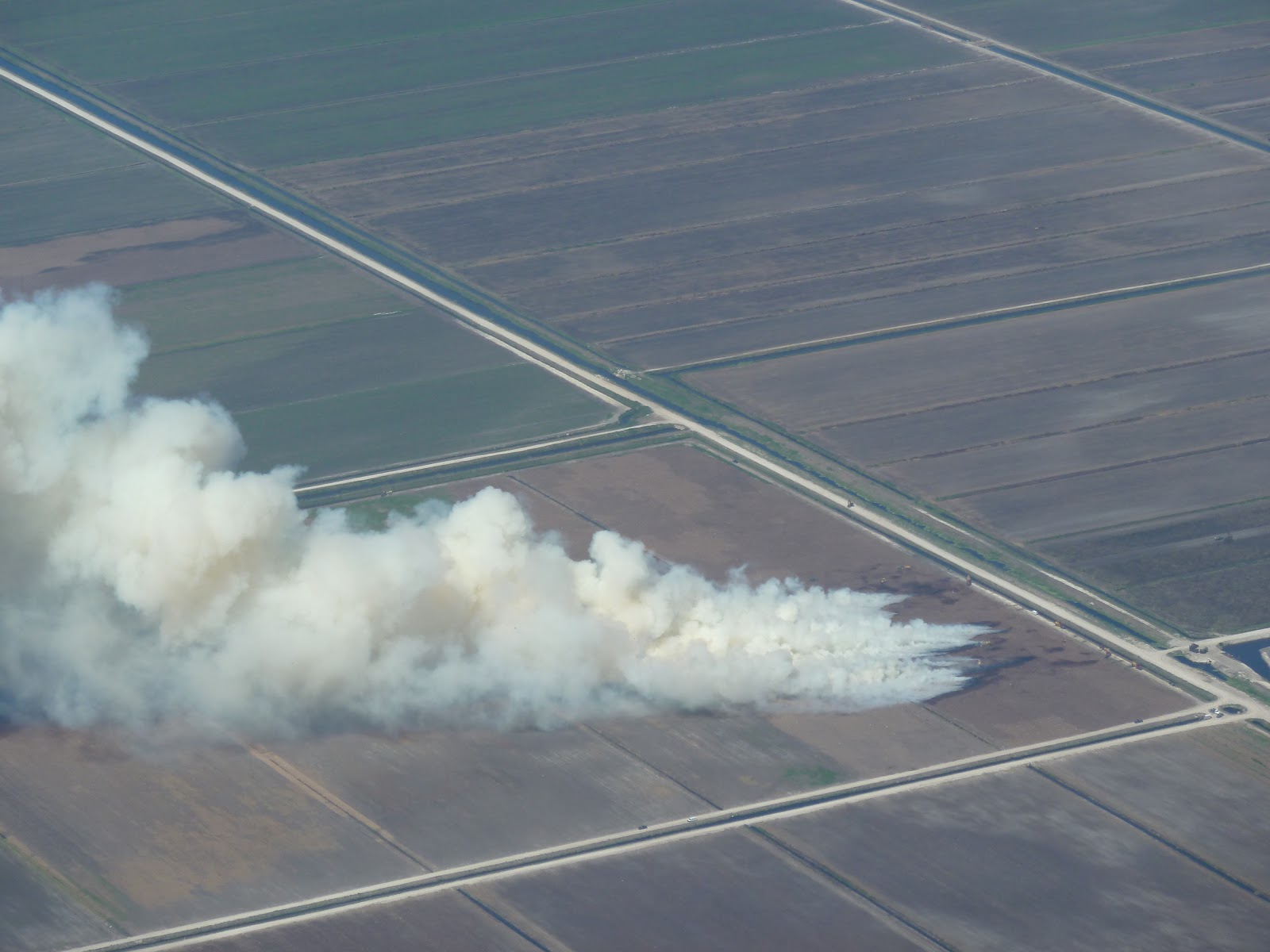
Having got one over on ATC I continued my journey passing Vero Beach, Fort Pierce and Stuart. In land I could see a large fire taking place on the ground causing quite a few problems for a number of aircraft on the same frequency who were suffering from reduced visibility caused by the smoke.

With a bit of a tail wind causing a ground speed of 125kts (144mph) West Palm Beach (a large city north of Fort Lauderdale) came into sight.

The very nice lady on West Palm Approach frequency asked me which runway I would prefer - 9L or 9R. Considering where the port is placed and my route after leaving the runway in Fort Lauderdale I opted for 9R which would allow me a low pass over the shoreline. Little did I know - this wouldn't just be a short trip at such a low altitude!

"2FT, descend and maintain 2,500ft. On approach you will head directly over the field to enter the right downwind for 9R. Maintain 2,500 until turning downwind."

What I was hoping for! Directly passing over the airport before turning to make an approach on to the requested runway - this was turning out to be a good day!

"2FT, cleared for touch and go. After departure, head east until the shoreline. Upon reaching the shoreline head north at or below 500ft."

500ft?! This was going to be fantastic!

While turning final I was asked the following by ATC. "2FT, out of your left side, confirm sight of traffic. Type Jetblue Airbus A320 on short final runway 9L."

I looked to my left and in what looked like an arms length a European manufactured commercial airliner was partnering me on to solid ground. A mesmeric sight.


A quick touch and go in a windy Fort Lauderdale and I was airborne within a very short period of time. It was very odd leveling out at 500ft . Our standard procedure is to climb on runway heading to at least 700ft before making a turn.

Cruising over the shoreline at 500ft I made a turn towards home. The coast would take me directly back to the home city here in the US. I asked on a number of occasions to be cleared back to a reasonable cruising altitude but was refused every time; I wasn't complaining too much - the views were fantastic!

Finally, having passed below the airspace surround West Palm Beach their approach allowed me to climb up to a respectable 4,500 feet for the journey back to Melbourne.


It was a pleasant flight back. The winds were as predicted and it took some time for the international airport to come in to sight.

Due to the ATC dodging earlier in the morning I had used up the allocated time I was allowing for a few landings and also owing to a well overdue bathroom break I proceeded back to the ramp.

The winds had considerably increased since the departure three hours earlier so it made for a challenging yet satisfying approach.

Three wheels on the ground I taxied back to base and shut down the engine. Arguably my favourite flight yet.


Today was the same story as that of Friday. The winds were predictable last night and having exceeded 30kts today it was a certainty that another enjoyable afternoon in the air wasn't going to happen.

Tomorrow is the start of three days I have been looking forward to for months. We're finally going to be taking our upset recovery training.

This involves a ground school covering the subjects we will be learning about over the coming three days followed by five hours in the Extra 300 (those famously used in the Red Bull air races.

This course is designed pretty much as described. To train pilots on how to recover from flight situations which can be extremely dangerous to both the aircraft, those on board and people on the ground. There have been a number of incidences where an aeroplane has got itself into a situation whereby the pilot's are not trained to deal with. I am of the understanding that a number of the maneuvers that we will be covering are also not taught in the simulator training during the type rating stage of training.

I'm also hoping we can do a couple of loops too!

Tomorrow also is the day that some of the family is coming out to visit. Arguably not the best time (although since last summer there hasn't really been any good time!) to come out but I'll hopefully get to see them as much as possible.

With the weather causing problems and a list of flights I need to get through it looks like the next five or six weeks will be extremely busy and there will simply be no time for rest.

Pretty similar to the past six months really...