Showing posts with label Cross Country. Show all posts

Sunday, 1 April 2012

Knocking down the hours...Part II


Firstly, sorry for the long time between updates - I've been extremely busy this past week or so!

I know sit here writing having completed all of my single engine hours. Tuesday was the final day of making up time I was short.

Over the past week I have done so much with my flying it has been great and it is sad to see the end to the work horse that is the Piper Warrior. The thousands of miles I've taken inside the cockpit of the aircraft produced only down the road in Vero Beach have been busy, sometimes stressful, challenging and most importantly thoroughly enjoyable.

As much as instructors try to say that every one of them is the same it really isn't the case. They each have their own ways - some are good climbers, others very responsive on the controls. One thing I can say about each and every Warrior here at FIT is that they're maintained to a world class standard by a truly fantastic team of mechanics who quite literally work through the night to make sure as many aircraft are available as possible for students and rentals to use; even if that can sometimes drop below the number so dearly needed. I'm sure everyone would agree that they'd rather have wait for an airworthy aeroplane than take one there and then that is not.


My final few flights included a trip across to Tampa and then on down to West Palm International before returning home. This four hour flight completed the two that are included in the programme. It is great to get out of the local area and explore some of the major airports in Florida, especially in a state that is designed more so for general aviation than any other location on the planet.

In the US the air traffic control is much more well invested than what we will be used to in Europe (although when flying with airlines there is very little difference). However, for general aviation here in America we can really take advantage of the services on offer, the most frequently used and user friendly being flight following.

As VFR pilots we're supposed to be flying by reference to what we can see outside of the aircraft. This is all well and good but when entering or maneuvering around airspace that has jets moving at over 200kts at flight levels similar to those we operate it really is of benefit to use ATC.

The majority of the time is spent under our own navigation but with the assistance of the controllers can be vectored on altitudes, headings and traffic advisories. Working in much heavier airspace is a great benefit as it increases the workload and prepares us for what we face ahead in our careers.

Using flight following on these legs was fantastic. In fact all the controllers over here are very good at what they do and are also very used to students who may not have the skills and knowledge in place to react as those with increasing full log books would do. It is also to their credit the amount of patience they have in dealing with such people, effectively from all corners of the globe.


My final solo flight (well, in the progamme) was a two hour navigation flight. Since arriving here in Florida and began to fly I have always wanted to go into Orlando International (MCO). It's the gateway to the world famous theme parks and the majority of traffic heading to the northern parts of the state.

Handling over 35 million passengers per year it puts it just ahead of the likes of Gatwick (albeit it with three additional runways) and the second largest here in Florida after Miami. The flight went very well and with the help of Orlando Approach and the tower I was in and out of the airport within minutes before heading back to the practice area to prepare for the internal check ride known as 3.D.15 due a couple of days after.


During the run in to completing my hours I was extremely lucky with the weather and aircraft availability. There has recently been a shortage in the number of planes, mainly caused by an unexpected rise in aircraft having to enter the hanger for maintenance issues. Hopefully this will be sorted as soon as possible and the usual number of aircraft available will resume.

After completing another two duals with my instructor I was then ready to take the all important 3.D.15.


3.D.15 is an internal check ride and is designed to be the final single engine flight students take before moving on to the twin engine Seminole to complete the Multi-engine Commerical Pilot's License (MEP/CPL). The flight is conducted by either the Chief Flight Instructor or another senior pilot within the company. The idea is to complete a full review of everything that we have learnt in the Piper Warrior and moving forward if we are prepared to cope with the increased work load experienced in it's larger brother.

The flight went well and having discussed my hours with the CFI I was told that I needed to complete an one hour solo and just under one hour dual to meet the minimum required hours outlined under the JAA scheme we currently reside under.

I spent one hour in the pattern here on my own before in the afternoon taking to the air on my final single engine flight.

My instructor and I decided we would head up to NASA and complete the low approach now possible over the 15,000ft runway.


With 0.9 of an hour it was going to be tight but managable. We made the low approach only 100ft above the runway heading over it to the north. We then made a right teardrop and flew down the opposite end to the south.

I wasn't aware of the shear size of the facility. Not only is the runway ridiculously long but the launch pads that we could see in the distance really did show the scale of the operation that has and continues to go on here in Florida.


It was quite surreal seeing below us where history has been made on so many occasions - a truly memorable trip that I would recommend to anyone who is flying general aviation or flight training here in Florida.

So, with 3.D.15 complete, my single engine hours in the record books it was time to prepare for the Seminole. As I said at the start, I've had a great time learning how to fly in the Warrior. It's an aeroplane I would almost insist anyone with a pilots license get to at least take for one or two flights.

A true work horse.


The Piper Seminole. The big brother to the Warrior. Two engines each producing 180bhp accelerate the aircraft to it's rotation speed of 75kts (just over 80mph) within seconds.

The design of each engine is more complex than that of the Warrior and it's something that is particularly interesting to learn. So far I have had one lesson in the twin with more coming over the next five days.

With the intensity of the course (the plan is to be out of here in just over two weeks) it's definitely worth getting as many back seats as it is possible. Over the last few days I have managed to get in the back for two flights.


With such an increase in the amount of work within a reduced time period as the plane travels at higher speeds that we're used to it is a great surprise but a challenge I'm sure we'll all relish.


Thursday, 22 March 2012

Knocking down the hours while the results arrive...Part I


Since the last update there have been developments both in the air and on the ground.

Firstly, and most importantly, the final ATPL results arrived last week and I'm happy to say all have been satisfactorily complete with the needed percentage gained. 

The exams have been a long, drawn out process and something I feel quite proud to have complete. They're not for the faint hearted and although I feel they hold an undeserved prestige of being difficult I do believe that they are the result of someone's extreme hard work and dedication.

I remember travelling to the Annex on our first day of ATPLs and a now friend said, as he was to begin his final module, that the six months following would be the quickest we would ever experience - I cannot emphasis how true those words were. 


They're the largest and most feared part of the training - something I am glad to never have to see again!

Having said goodbye to the family last week we were half way through out CPL ground school training. This course is designed as both a refresher and an introduction into flying a twin-engined aircraft under the JAA system.

During the five days of ground school we covered everything from engine failure on take-off to the phraseology that should be used in Europe (and supposedly across the world!) on the radios.

It was great to finally start to get to terms with a type of aircraft (twin) that I hope to be flying on a much greater scale in the near future. 

The ground course was completed with an exam on Monday morning which I am happy to say everyone comfortably passed.


More importantly over the past week or so I've managed to complete a serious number of flights. The only remaining flight I now have is an internal check ride with one of the senior flight instructors at the weekend before beginning in the Seminole.

Over the past week or so I have been extremely lucky in terms of weather and aircraft availability. A lot of friends and colleagues here have been turned away time and time again due to a large number of aircraft being broken and the weather not being as they had hoped.

I however have managed to log eight flights, exactly twenty hours of flight time with twenty seven takeoff/landings. This excludes the time flying with the family and the majority of this was fitted around the ground school.

It has been extremely tiring and frustrating but I have had a fantastic time with it all the same and managed to visit some fantastic places as I'll now explain below.


After completing a couple of duals on Thursday and Friday last week early morning, I had two four hour cross country flights to complete at the weekend with each lasting over 300NM with one leg being at least 150NM in length.

On Saturday I was planning to head from Melbourne to Titusville (just north of here) and then down to Naples on the west coast. This would allow me to cover the 150NM required on the day's routes. From Naples I was going to head down to Tamiami, an airport near the world famous Miami where I would refuel before heading back up the coast past the city as the sun fell. That was the plan anyway.

Due to the aircraft arriving back late it cut down the amount of time I would have to complete the route. Therefore I made a quick modification. I changed my final stop from Tamiami to West Palm International. Although the route would be shorter it would still be in excess of 150NM.


After heading up to Titusville I headed towards Okeechobee, the old stomping ground. This would be the point I would pass over en route to Naples. Having made contact with Miami Approach I was soon passed over to Fort Myers Approach who gave me vectors towards Naples. The weather wasn't the best. It was getting quite turbulent and the clouds started to move in, although they did remain quite sparse throughout the trip. A touch and go in Naples followed by a departure to the East back to the Atlantic coast line.


The flight across the state to West Palm was quite interesting as I was only covering the ground at around 85kts (98mph) compared to the outbound leg of 136kts (157mph). This made the leg in to almost an hour sector. 

Finally I arrived on the approach in to the airport.

"N369FT expect runway 10R, advise when you have Lima."

The approach plan was complete and the airport was in sight. 

"West Palm Approach, N639FT has the airport in sight."

"N639FT, West Palm Approach, contact Tower on 119.100"

The weather had really cleared as the sun started to set in my six o'clock. I was very much looking forward to the flight back up the coast to Melbourne.

"N639FT contact departure, have a good day."


The journey back along the coast was fantastic. I managed to climb to 8,500ft as the sun began to set over the sunshine state. I was able to get some fantastic photos.


It was soon time to start the descent in to Melbourne after a fantastic day out flying. The sun was soon over the horizon and darkness fell.

"FIT 39, cleared to land Runway 5." Home.


More to follow this weekend including another four hour solo, a trip to the largest airport in the state and overflying the NASA airport at 100ft.


Wednesday, 7 March 2012

Wind, wind and more wind...


Since the end of ATPLs it's all been about flying as much as possible. Flying is the sole restriction now (well...apart from an internal CPL test at the end of next week) between me and a twin-engined Piper Seminole.

My new instructor was quite pro-active and scheduled me for four solos over four days - fantastic! I had the opportunity to knock thirteen hours of flying within such a short space of time!

Eagerly checking the weather on Friday afternoon my heart sank. The weather on Saturday morning was to be fantastic. A cold from was passing from the north on Friday evening bringing with it some spectacularly high pressure the following morning. This is great for flying. Clear skies and cool temperatures are a pilots dream; what isn't is the winds that are almost always associated with it.

Winds gusting into the mid-twenty knots meant I wouldn't be getting back into the air as soon as I'd planned.


Sunday morning, god must have taken a rest and blessed us all with calm, cool conditions. Got to love that guy! 

Flight planning complete, it was time to head off to Fort Lauderdale! The flight was due to run just under three hours with strong northerly winds creating a fast outbound flight and a long, slow in bound journey. The plan was to enter the pattern in Melbourne on the return flight to finish off the journey.

I departed Melbourne and began the flight south. Melbourne international and the area around 20 miles south of the city comes under the ATC jurisdiction of Orlando Approach. For convenience it always seems easier to continue VFR squawking 1200 until reaching Sebastian, an un-towered airport on the boarder of Orlando/Miami Approach. 

"Miami Approach, N642FT with VFR request."

"N642FT, negative. Airspace too busy due to IFR traffic."

Just my luck. It was either continue the flight without flight following or head somewhere else, preferably north. It was at that point a cunning plan that'd I'd previously seen used entered my head. I turned around and pointed the nose in my original departure airport. Just outside of Melbourne's airspace I again made a 180 degree turn back to the south.

"Orlando Approach, N642FT with VFR request."

"N642FT go-ahead."

Result! This allowed me to register my flight following giving me ATC to Fort Lauderdale. Soon afterwards, as I again approached Sebastian airport I was passed over to Miami Approach.

"Miami Approach, N642FT with you."

"N642FT roger."


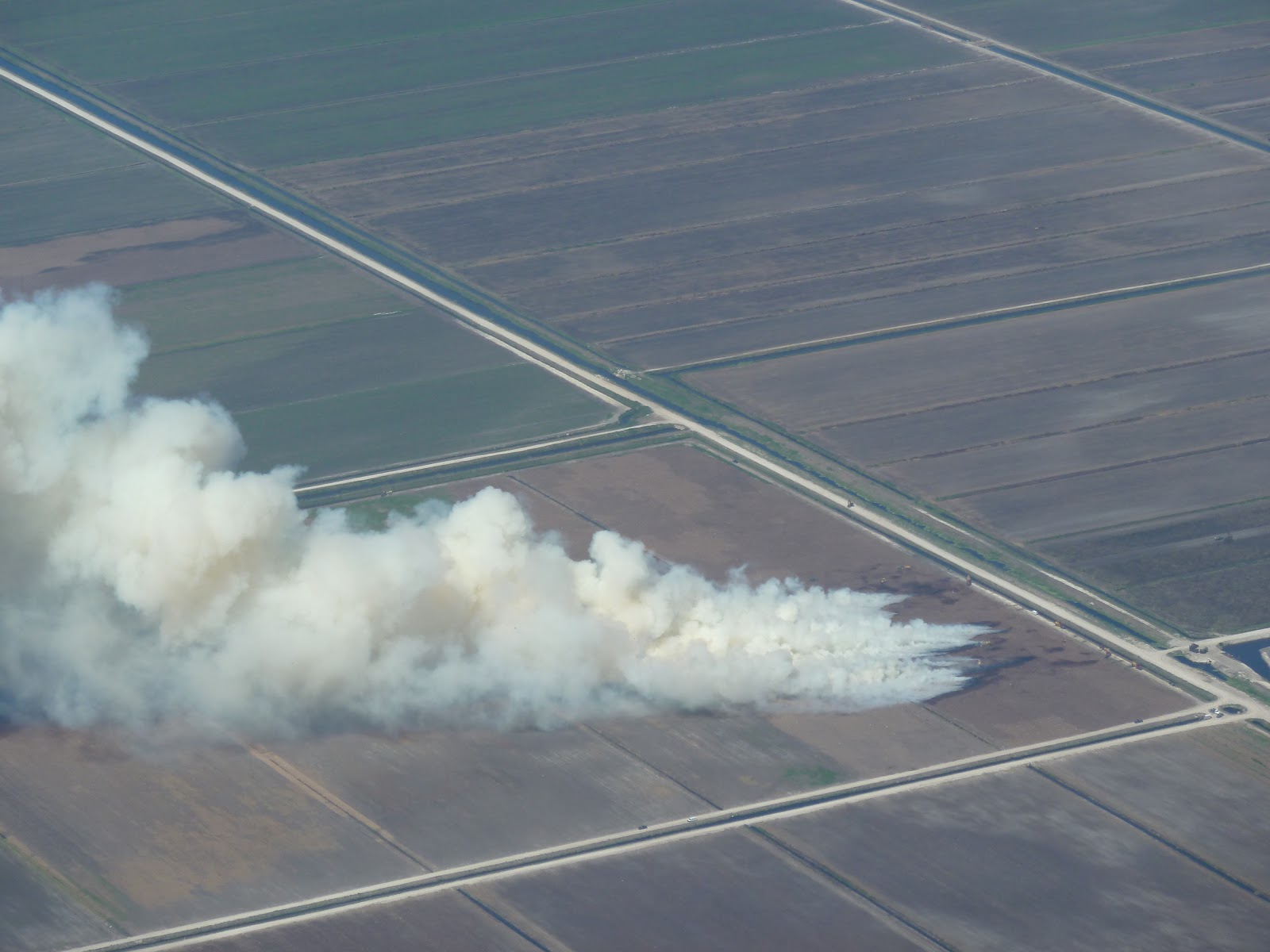
Having got one over on ATC I continued my journey passing Vero Beach, Fort Pierce and Stuart. In land I could see a large fire taking place on the ground causing quite a few problems for a number of aircraft on the same frequency who were suffering from reduced visibility caused by the smoke.

With a bit of a tail wind causing a ground speed of 125kts (144mph) West Palm Beach (a large city north of Fort Lauderdale) came into sight.

The very nice lady on West Palm Approach frequency asked me which runway I would prefer - 9L or 9R. Considering where the port is placed and my route after leaving the runway in Fort Lauderdale I opted for 9R which would allow me a low pass over the shoreline. Little did I know - this wouldn't just be a short trip at such a low altitude!

"2FT, descend and maintain 2,500ft. On approach you will head directly over the field to enter the right downwind for 9R. Maintain 2,500 until turning downwind."

What I was hoping for! Directly passing over the airport before turning to make an approach on to the requested runway - this was turning out to be a good day!

"2FT, cleared for touch and go. After departure, head east until the shoreline. Upon reaching the shoreline head north at or below 500ft."

500ft?! This was going to be fantastic!

While turning final I was asked the following by ATC. "2FT, out of your left side, confirm sight of traffic. Type Jetblue Airbus A320 on short final runway 9L."

I looked to my left and in what looked like an arms length a European manufactured commercial airliner was partnering me on to solid ground. A mesmeric sight.


A quick touch and go in a windy Fort Lauderdale and I was airborne within a very short period of time. It was very odd leveling out at 500ft . Our standard procedure is to climb on runway heading to at least 700ft before making a turn.

Cruising over the shoreline at 500ft I made a turn towards home. The coast would take me directly back to the home city here in the US. I asked on a number of occasions to be cleared back to a reasonable cruising altitude but was refused every time; I wasn't complaining too much - the views were fantastic!

Finally, having passed below the airspace surround West Palm Beach their approach allowed me to climb up to a respectable 4,500 feet for the journey back to Melbourne.


It was a pleasant flight back. The winds were as predicted and it took some time for the international airport to come in to sight.

Due to the ATC dodging earlier in the morning I had used up the allocated time I was allowing for a few landings and also owing to a well overdue bathroom break I proceeded back to the ramp.

The winds had considerably increased since the departure three hours earlier so it made for a challenging yet satisfying approach.

Three wheels on the ground I taxied back to base and shut down the engine. Arguably my favourite flight yet.


Today was the same story as that of Friday. The winds were predictable last night and having exceeded 30kts today it was a certainty that another enjoyable afternoon in the air wasn't going to happen.

Tomorrow is the start of three days I have been looking forward to for months. We're finally going to be taking our upset recovery training.

This involves a ground school covering the subjects we will be learning about over the coming three days followed by five hours in the Extra 300 (those famously used in the Red Bull air races.

This course is designed pretty much as described. To train pilots on how to recover from flight situations which can be extremely dangerous to both the aircraft, those on board and people on the ground. There have been a number of incidences where an aeroplane has got itself into a situation whereby the pilot's are not trained to deal with. I am of the understanding that a number of the maneuvers that we will be covering are also not taught in the simulator training during the type rating stage of training.

I'm also hoping we can do a couple of loops too!

Tomorrow also is the day that some of the family is coming out to visit. Arguably not the best time (although since last summer there hasn't really been any good time!) to come out but I'll hopefully get to see them as much as possible.

With the weather causing problems and a list of flights I need to get through it looks like the next five or six weeks will be extremely busy and there will simply be no time for rest.

Pretty similar to the past six months really...


Sunday, 8 January 2012

Back in at the deep end


So I'm now back in Florida and it's been a tough couple of days with more to come!

I left a very windy Manchester on Thursday morning and made my way back across the Atlantic to Orlando and then on to Melbourne in the Sunshine state. Leaving Manchester was quite interesting. As many in north western Europe will know the winds have been extremely strong over the past week and come 10.30am on Thursday it was no different. The winds were so strong that as we boarded and waited to leave the gate the plane could be felt rocking in the airflow. Not only this, upon pushing back from the gate we had to wait for twenty minutes due to cargo containers sat by aircraft stands which had been carried by the weather and were now sat covering the main taxiways. The captain advised he would refrain from starting the taxi until all had been safely removed to save 'embarrassment' on behalf of the airline and airport in the case of one again been thrown into the air and in the worst case scenario striking the aircraft.

Anyway, we were soon airborne and after an extremely bumping departure we quickly got above the clouds and on our way to the US.

After landing in Orlando I joined the long and laborious immigration line which lived up to it's infamous name. Finally arriving at the desk I was asked kindly to follow the immigration official into a room for secondary checks. I wasn't thoroughly informed as to why this was the case at the time but soon enough my documents were returned and I was able to leave the arrivals facility and meet up with some of my fellow students before the journey back to Melbourne.


Shortly after arriving back and unpacking I was on to the computer to see if any flights had been scheduled by my instructor. True to his word the following morning I would be flying bright and early - at 7am. I'd been awake many hours and with the five hour time difference it added extra time on to an already long day. I had to get some shut eye.

Waking up the following morning bright and early (not long after 5am!) I headed to the Flightline. Since returning I was quickly informed that the weather was not what it had been when we left less than three weeks ago. It was apparently much cooler when the sun set and as was said I soon felt the chill (even after enduring the English winter for two weeks) of a cool Floridian January morning.

The aircraft was prepped and ready to go. Just one problem - mist. Unfortunately until the obscurity had burnt itself off it wasn't possible to get back into the air for the first time in 2012. To keep the plan alive I delayed the flight and went for breakfast at a local diner with three other students. Arriving back around 10am the weather had improved quite considerably and I was able to soon get back into the seat and head towards the runway.

The checklist had been thoroughly 'checked' and I sat there, waiting to make my first radio call of the new year. If I was to ask every student here the worst part of the flying (apart from the paperwork of course) the majority would most likely say it is making that initial radio call at the run up area. It's a very simple request to the controller and we have all done in many times yet it's one of those things that we all just have to sit there for all but a couple of seconds and just think - "what on earth do I have to say?!"

Luckily I got the first call under my belt correctly and it all flowed back. Within minutes I was pointing towards the sky and heading south. The air was still cool which helped the aeroplane climb much quicker than would normally be the case. Soon enough I was at my cruising altitude of 6,500ft. Aircraft configured, radio checks complete and check lists again re-checked I got to again appreciate some of the glorious views on offer here on the east coast of the United States. Only twenty four hours earlier I was being rocketed into the tropopause in a metal (well...composite...) tube containing some of Europe's latest technology while now I sat in an aircraft designed in the seventies (albeit kitted out with twenty first century navigation equipment) cruising at 117 knots (135mph) just a mile above the earth's surface. The difference being, this time I was in control.

Soon enough I was ready to begin the descent into Okeechobee, somewhere I had been many times before. With the terminal information gathered (the weather for the particular airfield and any other relevant information) I began the approach. One thing was for certain - it was going to be quite windy!


After a few landings (which went OK - safe but not what passengers would 'appreciate' had their been many in the back) I headed back to Melbourne, this time at a lower altitude of 3,500ft. This allowed me to experience a more detailed view of the landscape and get some great shots.

"FIT 37, cleared to land Runway 5."

So that was that - first flight of 2012 complete. Although it had been quite an effort to get myself organised and ready for the trip so quickly after returning to the US I was especially pleased to get it under my belt.


Again today I was scheduled for a 7am solo flight. As yesterday I arrived nice and early and again the weather told the same story - fog. Due to me also having a dual flight with my old instructor at 10.30am I unfortunately had to cancel the flight as I simply did not have the time to wait and fit the journey in before the following lesson.

I'm hoping to get my FAA PPL in as soon as possible and after cancelling the mock check ride before going home for Christmas this has now been reorganised for Monday. Before this I wanted to get a flight in with either my current or old instructor so that I was able to iron out any creases that had formed over the past few weeks on the ground while at home in Europe - and indeed there were a few!

Luckily I was able to get a flight with my old instructor who took me up for two hours and went through the majority of the procedures and manoeuvres that would be covered in the FAA check ride. It was great to get some feedback on areas I need to work on and hopefully there will be an improvement come the mock flight.

So, having gotten out of bed at not long after 5am for the past couple of days I was looking forward to taking the Sunday off to relax before the flight on Monday and the ATPL classes which start again on Tuesday but no, tomorrow morning by 6am at the very latest I'll be at the Flightline preparing another solo cross country flight. It's certainly not something that I am complaining about and I am extremely happy to be getting as many flights as possible under my belt as the CPL training lies only nine weeks away.

So, a busy few days and a few more to come - and that's before we start class again this week!

Next week I'll give more information on the final module including the subjects and the new changes with regards to the timetables.

Time for bed - another early start in the morning.

Sunday, 23 October 2011

Operation Module 1: Complete


So they're done. Four exams and two hundred and ten questions over four and a half hours.

The exams were all taken at the Hilton Hotel in Melbourne over three days. They were conducted by the IAA examiners and concluded on Wednesday afternoon.

Overall I thought they were as expected although the Instruments exam was something else and I'm more than interested to see what that particular result will be! Having spoken to a number of people who have taken the exam in the past the majority seem to find it the hardest to swallow of all fourteen.

Anyway, since Wednesday afternoon it's been four full days off from any form of aviation theory...well almost. In the evening I went out for something to eat with the rest of the class before getting a well earned lie in on the Thursday morning.

Thursday was spent relaxing and just enjoying not having to look in any books! Friday however was a bit different. I was in fact hoping to get a flight with my old instructor in the morning however having arrived at the Flightline there were no planes available.

Instead, we did ground school which was a little embarrassing. When becoming engrossed in the European material it is amazing how much of the American stuff I have come to forget! We covered different subjects regarding airspace, map reading and aircraft equipment - subjects I should really know!

Anyway, in the afternoon I was again hoping to get in the air and back seat a flight to Lakeland but again due to aircraft availability we were grounded. More ground school! I was kind of hoping that I would be able to avoid all forms of aviation related thinking over the six days off however I think it was invaluable to actually get back into it and realise how much I really do need to brush up on!


This morning I woke up early to watch the Manchester derby. Since Manchester City have seen unparalled investment over the past couple of years the team finds themselves the holders of the world's oldest cup, in the Champions League for the first time and making their way towards real title contenders come May. Thirty minutes or so into today's game I fell back to sleep and woke after the full time whistle - thank goodness I didn't want the entire game!

Anyway, having seen Chelsea lose and the thought of going to Tampa this evening (after I finish my flight plan!) on a night cross-country flight I am trying to stay positive.

Hope to have a post up about tonight's flight later in the week - back to ground school come Wednesday!


Wednesday, 28 September 2011

Life...


A surreal weekend - one I'm going to find hard to describe; certainly the most difficult post to date and most likely the most difficult for some time...

Since the last update six more days have passed and I'm guessing it's getting a bit boring me repeating the usual "it's going so fast" comment but it really is! We finished ground school last Thursday and headed out for a meal on Thursday night to celebrate the birthdays of two on my course - benefit being two cakes!

I was in fact hoping to fly early on Friday morning but having checked the internal scheduling system on Thursday evening nothing was showing hence I stole a few extra winks the following morning. Waking around 9.30am I found a few messages both in my email inbox and on Facebook. Quickly reading through the information in front of me it was clear that all students at Pilot Training College (PTC) had been grounded by Florida Institute of Technology (FIT) Aviation until further notice. So whether I was to fly that morning or not - we shall never know!

With hundreds of students out here now not able to continue the training in the way that they would have liked to, the rumours in turn obviously began both on line and off. A statement was quickly issued to ourselves via PTC's internal portal and we were told it would be resolved as soon as possible. Come early evening another statement was made that we would indeed be able to return to the skies first thing on Sunday morning. I don't think it is my place or indeed necessary to go into the details that we have been told concerning the grounding other than that it was a disagreement between the two respective companies which was quickly resolved. I am aware that a joint press release will be issued by the companies in the coming hours - something I will hopefully be able to attach a link to.


Friday was therefore spent revising and trying to avoid the rumour mill as much as possible.

Saturday was again a day of revision interrupted by FIT's Aviation Day. I didn't in fact attend although arrived as the proceedings were coming to a close to conduct ground instruction with my flight instructor. Along with ATPLs and flying I'm still (slowly!) working towards the American FAA PPL which I'm hoping to attain in the coming weeks. This involves covering quite a bit of theory material with my instructor for the oral part of the check ride before the flight. A couple of hours later it was back home to the books.

The same evening over twenty new students arrived from both Kazakhstan and Europe to start their training here in Florida over the next ten to twelve months.

After an 'eventful' Friday and indeed Saturday; Sunday was certainly the worst day since we have been here in America.

The day again was full of revision (I hope you don't get bored of me saying this over the next four months as it continues!) and then I had a cross country flight planned in the evening. Come 3pm I set off for the Flightline. The weather wasn't looking promising and I was almost certain the flight would be cancelled. As expected, the weather was not playing the way it had been over the past couple of weeks and it was time for more ground school with my instructor.

With regards to what happened later that evening back at Southgate I do not want to go into any detail whatsoever yet as it would be very unfair of me to say anything. However what I will say; what did happen certainly puts life into perspective.

I would also like to point out, as stressed in the replies to emails I received, this blog is very much the experiences that I personally am experiencing during my training. I try not to make political points and focus mainly on what the course of instruction is like here at PTC Florida and in the future Ireland. What has happened over the past few days is for those who use forums to discuss, squabble and argue over. I want this to be a place for those wanting to know about what life is like for a 20-year-old training to be a pilot with PTC here in the US.

Yesterday class was cancelled this morning due to the previous evening and started promptly again at 1.15pm in the afternoon.

Today two of the final weekly tests were complete in AGK and Performance followed by the other two tomorrow. Today was also the last Performance lesson ever (I hope!)

Yesterday evening we received two emails detailing both the consolidation exam timetable and the real IAA exam timetable for three weeks time.

Soon they'll be here - just one more hurdle in each subject to reach them...

Wednesday, 10 August 2011

Back seating


Saturday morning, 5.15am. Alarm goes off. Weary eyed I rise out of bed and get ready for my 8am solo flight.

I arrive at the Flightline around 6.15am and finish my flight planning. After checking the weather on the computers it looks like it's going to be a very good morning. The round robin flight would involve heading from Melbourne down to Stuart on the Atlantic coast before heading inland to Okeechobee and then back north to base.

map

The flight block time is scheduled as two hours and handy enough the actual flight should take a similar time including start up, taxi and shut down.

Paperwork complete, aircraft prepared I headed out to the run up area and completed the next couple of sections on my check list.

"Melbourne Tower; FIT 40 is holding short of Runway 23 at Echo, ready for departure."

"FIT 40 cleared for take-off Runway 23 at Echo."

Transponder set to ALT, flaps set, landing light on, mixture fully rich, throttle advance, temperatures and pressures in the green, airspeed is alive.

Into the morning sun the warrior climbs (at quite an impressive rate) as I direct her to the first way point en route to the first stop of the morning - Stuart.

I had yet to visit Stuart, a similar yet smaller airport to Melbourne but still controlled. There were no clouds at this time in the morning so the climb to 5,500 feet was smooth, uneventful and rather rapid. I was rather impressed with this particular airframe!


I've explained before the number of checks en route we are to conduct and this flight was not much different. I pride myself in trying to stay ahead of the aircraft and ten nautical miles north of Stuart I was ready to make my approach.

"Stuart Tower, good morning; 640FT is five miles north of the airfield, requesting touch and go and departure to the west with Bravo."

"640FT good morning; enter midfield for the left downwind for Runway 7. Report downwind."

Easy enough. Airport diagram out and time to plan the route towards the reporting point.

"Stuart Tower, 640FT is on left downwind for runway 7."

"640FT, cleared to land runway 7, fly runway heading after departure."

I've said this before and I'll say this again - landings always seem to come off better on solos! I'd like to think I'm quite critical of myself but I was extremely proud of my landing in Stuart and the one to follow in Okeechobee.

After touchdown, flaps were retracted and full power applied until the Piper Warrior was back where she had spent the last thirty five minutes.

"640FT, make left traffic runway 7, depart on course, free to change frequency above 2,500ft, good day."


The third and final airport of the day, Okeechobee is fast becoming an old favourite...well old at least. The airport is not towered meaning traffic has to be conducted by oneself and those flying and taxiing around the airfield.

A quick check of the weather and traffic frequency and I established Runway 5 was open. To enter the pattern it would involved overflying the airfield at 1,500 feet and then making a right tear drop approach to enter the left downwind for Runway 5 (see below).


A quick touch and go (again impressing myself!) and then back up to Melbourne.

By this time the clouds had started to move in and form. My planned altitude of 5,500 feet was scuppered the further I got towards Melbourne. 3,500 feet; 3,000 feet; 2,500 feet; 2,000 feet; 1,500 feet. Luckily by this time I was approaching the reporting point for Melbourne and I was able to descend to 1,000 feet and ask for a full stop landing.


"Melbourne Tower, FIT 40 is over Abandoned, 1,000 feet. Request full stop with Victor."

"FIT 40, fly straight in Runway 5. Cleared to land Runway 5."

A bit of a crosswind caught me out on final but other than that a safe landing and then taxi back to the ramp to park up. Overall a very enjoyable flight!


The progress test ride is fast approaching (hopefully early next week) and therefore I'm starting to get as much back seating in as possible. After the night flight last week (which I must admit was much more for enjoyment and inquisitiveness) I've not had much time in the back of the plane until today.

Back seating, as described before, is basically sitting in the back of the aircraft of another student's lesson. It takes away the stresses and distractions of A.N.C. - aviate, navigate and communicate and allows the back seater to concentrate on the areas he/she sees fit. This maybe listening to the radio calls, looking at how procedures are carried out or how manoeuvres are completed etc.

Today I was glad to get into the air for two back seat flights both covering similar lesson plans to mine over the next week or so. We're all pretty close to our progress check therefore getting in the back is as I said the other day, repetition. Seeing things happen more often certainly helps in cementing them in the brain and almost making them second nature. By being able to identify immediately the procedure and execution of any instruction is great and allows more time to be spent flying the aeroplane.


Anyway, up at 5.30am this morning and out of the door forty minutes later. Just after 7am we were airborne for the first fight of the day. I was due to fly again at 10am and then my own flight at 1pm.

As we move ever closer to the progress test we have been covering a lot of material that will have been forgotten since the start of the flying course. This includes everything from stalls to different types of landings.


Steep Turns

Steep turns are quite fun to do and are certainly key for any private pilot. Firstly the student pilot completed a thorough look out of the area for any traffic that may interrupt the manoeuvre. Once this is complete he enters a thirty degree bank to the left while maintaining his current altitude. Here (luckily for him this was the steep turn I recorded!) he executes this. Often an increase in power is needed to maintain the altitude.

His/her turn should continue for a full 360 degrees before arriving back at the original heading. Exactly the same is done to the right following this.

The idea of controlled steep turns is to allow the pilot to manoeuvre the aircraft more quickly and effectively and can be very good in sticky situations such as busy airspace.


Stalls

The primary learning point of a JAA stall is not how to actually stall the aircraft but more so how to recover from it.

Here my colleague enters his lookout turn before leveling off and slowing down while still maintaining his altitude. To maintain the altitude he must increase his angle of attack. Upon reaching the critical angle of attack the aircraft will buffer and then fall into a stall. You'll hear the aircraft stall warning horn go off as he approaches such an angle. 

As the aircraft begins it's stall he must be able to recover by dropping the nose, adding full power and adding a touch of right rudder to compensate for the P-factor caused by the engine.

He must then return the aircraft to a controlled and steady climb the instructor tells him to do otherwise. 

After a few touch and goes in Valkaria and Melbourne we landed and returned to the ramp for the debrief and for to then get ready for my second back seat of the day.

10am came around and again we taxied to the run up area, checks complete and we departed to the practice area south of Melbourne. 

Along with those already covered above we also covered two other important components of any PPL holder or student pilot. Unusual attitudes and emergency landings.


Unusual Attitudes

Unusual attitude training is conducted at a safe altitude (above 3,000ft MSL) where the flight instructor will disorientate the student pilot (who has no visual reference) and then leave the aircraft in an unusual state. This is mostly in terms of the aircraft's pitch but also the roll (turn) of the aircraft.

The student pilot must return the aircraft to a straight and level flight.


Emergency Landing Procedures (in the pattern)

An emergency procedure landing at Valkaria airport in Florida. The instructor simulates an engine failure while the aircraft is on downwind to the intended runway. The student pilot must run through the procedure he has been trained to complete in order to land the plane safely. 

Note, the engine is set to idle and can be used to it's maximum capacity at any time should the situation arise that it be needed.

This basically involves initially correcting the speed for the optimum gliding speed which in the case of the warrior is 73 knots then checking anything that could have caused the engine to stop such as an empty fuel tank or trying ways to restart said engine. In the event of this failing it is time to prepare the aircraft for landing. This means securing the engine for touchdown and preparing to exit the aircraft at the soonest yet safest opportunity.

Engine out procedures are carried out at all different altitudes and terrain areas but today was focused on the engine failing while in the airport pattern. Further posts in the future will certainly include different engine failure scenarios. 


An almost identical flight complete and then to check the computers for the fore-coming weather over the following couple of hours. Not good reading. 'TSRA' - Thunderstorms with rain. Winds were over 20 knots and gusting into the 40s. I had seen the weather growing all morning and the radar confirmed my worst fears - the flight would be cancelled.

After an hour or so with my instructor with some quite helpful ground school it was time to return home. Although I'd not managed to actually get up myself it was good to get into the back of a couple of similar flights which will hopefully put me in good stead for my next flight tomorrow lunchtime - if the weather isn't similar to today!

Saturday, 6 August 2011

Our new home


Nearly another week has passed and some more flying has been done. Not only work in the air but work on the ground has also been taking place as I write this from my new accommodation.

Last weekend dozens of students made moves to new residences across campus. For a number of different reasons since our arrival we were put into 'halls' where we each had a large room and a share bathroom.


Said building while on approach into Melbourne International (KMLB)

Each floor was split into north and south with a communal area in the centre. On the 'north side' there originally six of us but with a couple of additions and one leaving we ended up as a seven. The remainder of the male contingent of the course were on the 'south side' while our female colleagues were in a different hall on campus.

Anyway, it was announced we would be moving to our permanent accommodation last weekend and from Friday to Sunday it was time to pack up, move and unpack. Where we are now is a great improvement on where we were for the simple fact that we are now able to cook for ourselves (the halls had no cooking facilities other than a microwave). 

Each apartment comes with a kitchen, living area, bathroom and two bedrooms (I sound like an estate agent [or realator as they call them over here...])


New room here in Melbourne

Where I am now staying is called 'Southgate Apartments' and is where I will stay for the remainder of my training here in Florida. It is just across the road from the main Florida Institute of Technology campus.


Southgate Apartments while on approach into Melbourne International (KMLB)

Flying wise this week I've been focusing on preparing for my JAA progress test  in the coming week or so. The check is conducted internally by a JAA qualified instructor. The progress test covers everything required by JAA from stalls and cross country flying to different types of landings. More on that in a future post.

With my instructor we have been covering pretty much everything I have been doing over the past two months in the sky. I have never really been one for repetition but with each manoeuvre comes a different procedure and by doing each frequently and consistently I find it very beneficial. I'm sure all have improved considerably over the past week. 

During the past week I've also started to look at the dreaded ATPL material. The worst four letters in any JAA student pilot's training. Just mention those four letters in that order to any JAA trainee and you'll see their eyes wince, their skin go pale and a shiver as if someone had just walked over their grave.


Every pilot's nightmare - 'the ATPLs'

Six months, fourteen exams, three modules. Almost everything that you would want (and even wouldn't want!) to know about everything with the word 'plane' in it or associated to it is covered. Our first day of ground school begins on the 29th August putting it little over three weeks away. However I'm sure this subject will be exhausted on here over the next six to seven months. 

Finally, yesterday evening I back seated a night flight in the pattern here in Melbourne with a fellow student. Since arriving here I've wanted to get up at night as see the lights of the airport and the surrounding area. It didn't disappoint. Having arrived at the Flightline it was great to see how quiet and deserted it was. There was literally our flight and that would be it. All paperwork complete we headed out to the plane.

Due to work on the ramp the aircraft aren't currently parked in their normal parking spaces therefore after ten minutes or so we did eventually find our plane. Pre-flight complete, instructor ready, student ready, we headed out to the run up area where we would test the engine at a high RPM rate.

As my fellow student was running through his checks he noticed that in fact the flight controls (the yoke that makes the plane turn about two of it's axes) were not "full, free and correct." They were actually quite stiff so we returned to the ramp for a quick look by maintenance. A bit of WD-40 and a cloth did the trick and in no time we were back where we left off.

Taxiing to the runway I was a bit taken aback by the difference of flying during the day. Obviously I expected the visuals to be different but the beauty of a lit up airfield was truly fantastic.

We departed on Runway 27L and entered the pattern on Runway 27R. The instructor was very keen to put his student through his paces by having him land in different configurations and landing types. 

Runways 5/23 and 9L/27R are much shorter than the main runway 9R/27L and only the latter has lights running down the centreline. It wasn't until the second to last landing (below) as we turned onto final and you could see the whole runway lit up like a Christmas tree that I realised how much I'm going to love night flying.


Landing at night on Runway 27L at KMLB

The best part of the evening by far was when the instructor, after take-off following the above video asked if she would be so kind to turn of the centreline lights for the final approach - much to the disapproval of the student! 

Tomorrow I hope to get in my second cross country solo done and then early next week get back into it with my instructor.