Showing posts with label Weather. Show all posts

Wednesday, 7 March 2012

Wind, wind and more wind...


Since the end of ATPLs it's all been about flying as much as possible. Flying is the sole restriction now (well...apart from an internal CPL test at the end of next week) between me and a twin-engined Piper Seminole.

My new instructor was quite pro-active and scheduled me for four solos over four days - fantastic! I had the opportunity to knock thirteen hours of flying within such a short space of time!

Eagerly checking the weather on Friday afternoon my heart sank. The weather on Saturday morning was to be fantastic. A cold from was passing from the north on Friday evening bringing with it some spectacularly high pressure the following morning. This is great for flying. Clear skies and cool temperatures are a pilots dream; what isn't is the winds that are almost always associated with it.

Winds gusting into the mid-twenty knots meant I wouldn't be getting back into the air as soon as I'd planned.


Sunday morning, god must have taken a rest and blessed us all with calm, cool conditions. Got to love that guy! 

Flight planning complete, it was time to head off to Fort Lauderdale! The flight was due to run just under three hours with strong northerly winds creating a fast outbound flight and a long, slow in bound journey. The plan was to enter the pattern in Melbourne on the return flight to finish off the journey.

I departed Melbourne and began the flight south. Melbourne international and the area around 20 miles south of the city comes under the ATC jurisdiction of Orlando Approach. For convenience it always seems easier to continue VFR squawking 1200 until reaching Sebastian, an un-towered airport on the boarder of Orlando/Miami Approach. 

"Miami Approach, N642FT with VFR request."

"N642FT, negative. Airspace too busy due to IFR traffic."

Just my luck. It was either continue the flight without flight following or head somewhere else, preferably north. It was at that point a cunning plan that'd I'd previously seen used entered my head. I turned around and pointed the nose in my original departure airport. Just outside of Melbourne's airspace I again made a 180 degree turn back to the south.

"Orlando Approach, N642FT with VFR request."

"N642FT go-ahead."

Result! This allowed me to register my flight following giving me ATC to Fort Lauderdale. Soon afterwards, as I again approached Sebastian airport I was passed over to Miami Approach.

"Miami Approach, N642FT with you."

"N642FT roger."
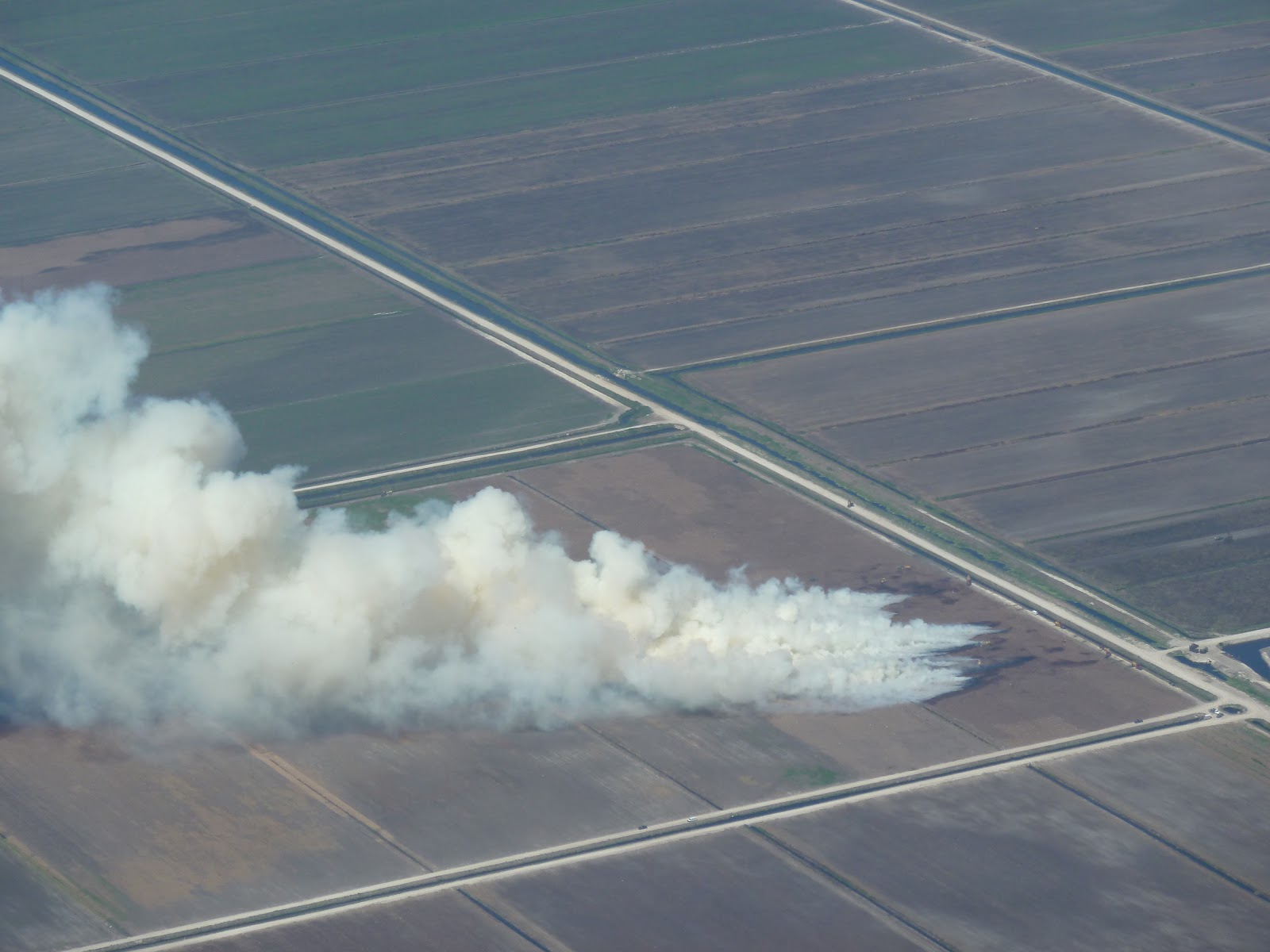

Having got one over on ATC I continued my journey passing Vero Beach, Fort Pierce and Stuart. In land I could see a large fire taking place on the ground causing quite a few problems for a number of aircraft on the same frequency who were suffering from reduced visibility caused by the smoke.

With a bit of a tail wind causing a ground speed of 125kts (144mph) West Palm Beach (a large city north of Fort Lauderdale) came into sight.

The very nice lady on West Palm Approach frequency asked me which runway I would prefer - 9L or 9R. Considering where the port is placed and my route after leaving the runway in Fort Lauderdale I opted for 9R which would allow me a low pass over the shoreline. Little did I know - this wouldn't just be a short trip at such a low altitude!

"2FT, descend and maintain 2,500ft. On approach you will head directly over the field to enter the right downwind for 9R. Maintain 2,500 until turning downwind."

What I was hoping for! Directly passing over the airport before turning to make an approach on to the requested runway - this was turning out to be a good day!

"2FT, cleared for touch and go. After departure, head east until the shoreline. Upon reaching the shoreline head north at or below 500ft."

500ft?! This was going to be fantastic!

While turning final I was asked the following by ATC. "2FT, out of your left side, confirm sight of traffic. Type Jetblue Airbus A320 on short final runway 9L."

I looked to my left and in what looked like an arms length a European manufactured commercial airliner was partnering me on to solid ground. A mesmeric sight.


A quick touch and go in a windy Fort Lauderdale and I was airborne within a very short period of time. It was very odd leveling out at 500ft . Our standard procedure is to climb on runway heading to at least 700ft before making a turn.

Cruising over the shoreline at 500ft I made a turn towards home. The coast would take me directly back to the home city here in the US. I asked on a number of occasions to be cleared back to a reasonable cruising altitude but was refused every time; I wasn't complaining too much - the views were fantastic!

Finally, having passed below the airspace surround West Palm Beach their approach allowed me to climb up to a respectable 4,500 feet for the journey back to Melbourne.


It was a pleasant flight back. The winds were as predicted and it took some time for the international airport to come in to sight.

Due to the ATC dodging earlier in the morning I had used up the allocated time I was allowing for a few landings and also owing to a well overdue bathroom break I proceeded back to the ramp.

The winds had considerably increased since the departure three hours earlier so it made for a challenging yet satisfying approach.

Three wheels on the ground I taxied back to base and shut down the engine. Arguably my favourite flight yet.


Today was the same story as that of Friday. The winds were predictable last night and having exceeded 30kts today it was a certainty that another enjoyable afternoon in the air wasn't going to happen.

Tomorrow is the start of three days I have been looking forward to for months. We're finally going to be taking our upset recovery training.

This involves a ground school covering the subjects we will be learning about over the coming three days followed by five hours in the Extra 300 (those famously used in the Red Bull air races.

This course is designed pretty much as described. To train pilots on how to recover from flight situations which can be extremely dangerous to both the aircraft, those on board and people on the ground. There have been a number of incidences where an aeroplane has got itself into a situation whereby the pilot's are not trained to deal with. I am of the understanding that a number of the maneuvers that we will be covering are also not taught in the simulator training during the type rating stage of training.

I'm also hoping we can do a couple of loops too!

Tomorrow also is the day that some of the family is coming out to visit. Arguably not the best time (although since last summer there hasn't really been any good time!) to come out but I'll hopefully get to see them as much as possible.

With the weather causing problems and a list of flights I need to get through it looks like the next five or six weeks will be extremely busy and there will simply be no time for rest.

Pretty similar to the past six months really...


Tuesday, 14 February 2012

Crunch time


I will now pre-warn you. The updates over the next two weeks will probably be the most boring so far on the blog. It's not something I'm planning - but it's certainly something that is going to happen as the exams approach.

Since last week it's again been head in the books so to speak as we prepare for the coming exams. This time next week two of our PTC Consolidation tests (Air Law and Meteorology) will be completed and I'll be sat in this same spot trying to get my head around Human Performance/Limitations and Operational Procedures.

There have been times over the past few days where I've become frustrated and quite frankly bored of what I'm studying. The workload in this module is by far the greatest and with the end so close that final push is getting pretty difficult to muster.

I keep saying to myself "it's just two weeks; it's just two weeks" and it's slowly starting to work.

So, with six classes left this week it'll soon be the end of ATPL Ground School for good - or at least that's the plan anyway!


Other than spending many hours revising I was due to fly yesterday. The weather when I woke was an extremely cool 2 degrees Celsius - something I'm sure many in the UK and around Europe can relate to at the moment!

The sky was stunningly clear with views to the highest of the heavens; and with the temperature being so low it looked like a perfect day to go flying. I was planning to head across to Tampa and then into Orlando but arriving at the Flightline I was faced with the problem of winds.

Restrictions imposed by the flight school on pilots means that yesterday nearly all flights were grounded until the wind died down. Due to the busy schedule and the persistence of the winds (which were gusting into the mid-20kts) I had to cancel.

So it was back to Southgate to again get the head down for the exams next week.

Today however was a different matter. After cramming for the majority of the day I headed again to the Flighline to get into the air for two flights merged into one. When a pilot with PTC completes their FAA PPL check ride they have to complete two further lessons - both being one hour in the pattern here in KMLB.

With the lack of time available at the moment I wanted to kill two birds with one stone and duly after 2.3 hours and 27 landings I arrived back at the ramp before heading home.

Last week of Ground School starts tomorrow - lets hope it goes as quickly as it has done over the past six months!

Sunday, 8 January 2012

Back in at the deep end


So I'm now back in Florida and it's been a tough couple of days with more to come!

I left a very windy Manchester on Thursday morning and made my way back across the Atlantic to Orlando and then on to Melbourne in the Sunshine state. Leaving Manchester was quite interesting. As many in north western Europe will know the winds have been extremely strong over the past week and come 10.30am on Thursday it was no different. The winds were so strong that as we boarded and waited to leave the gate the plane could be felt rocking in the airflow. Not only this, upon pushing back from the gate we had to wait for twenty minutes due to cargo containers sat by aircraft stands which had been carried by the weather and were now sat covering the main taxiways. The captain advised he would refrain from starting the taxi until all had been safely removed to save 'embarrassment' on behalf of the airline and airport in the case of one again been thrown into the air and in the worst case scenario striking the aircraft.

Anyway, we were soon airborne and after an extremely bumping departure we quickly got above the clouds and on our way to the US.

After landing in Orlando I joined the long and laborious immigration line which lived up to it's infamous name. Finally arriving at the desk I was asked kindly to follow the immigration official into a room for secondary checks. I wasn't thoroughly informed as to why this was the case at the time but soon enough my documents were returned and I was able to leave the arrivals facility and meet up with some of my fellow students before the journey back to Melbourne.


Shortly after arriving back and unpacking I was on to the computer to see if any flights had been scheduled by my instructor. True to his word the following morning I would be flying bright and early - at 7am. I'd been awake many hours and with the five hour time difference it added extra time on to an already long day. I had to get some shut eye.

Waking up the following morning bright and early (not long after 5am!) I headed to the Flightline. Since returning I was quickly informed that the weather was not what it had been when we left less than three weeks ago. It was apparently much cooler when the sun set and as was said I soon felt the chill (even after enduring the English winter for two weeks) of a cool Floridian January morning.

The aircraft was prepped and ready to go. Just one problem - mist. Unfortunately until the obscurity had burnt itself off it wasn't possible to get back into the air for the first time in 2012. To keep the plan alive I delayed the flight and went for breakfast at a local diner with three other students. Arriving back around 10am the weather had improved quite considerably and I was able to soon get back into the seat and head towards the runway.

The checklist had been thoroughly 'checked' and I sat there, waiting to make my first radio call of the new year. If I was to ask every student here the worst part of the flying (apart from the paperwork of course) the majority would most likely say it is making that initial radio call at the run up area. It's a very simple request to the controller and we have all done in many times yet it's one of those things that we all just have to sit there for all but a couple of seconds and just think - "what on earth do I have to say?!"

Luckily I got the first call under my belt correctly and it all flowed back. Within minutes I was pointing towards the sky and heading south. The air was still cool which helped the aeroplane climb much quicker than would normally be the case. Soon enough I was at my cruising altitude of 6,500ft. Aircraft configured, radio checks complete and check lists again re-checked I got to again appreciate some of the glorious views on offer here on the east coast of the United States. Only twenty four hours earlier I was being rocketed into the tropopause in a metal (well...composite...) tube containing some of Europe's latest technology while now I sat in an aircraft designed in the seventies (albeit kitted out with twenty first century navigation equipment) cruising at 117 knots (135mph) just a mile above the earth's surface. The difference being, this time I was in control.

Soon enough I was ready to begin the descent into Okeechobee, somewhere I had been many times before. With the terminal information gathered (the weather for the particular airfield and any other relevant information) I began the approach. One thing was for certain - it was going to be quite windy!


After a few landings (which went OK - safe but not what passengers would 'appreciate' had their been many in the back) I headed back to Melbourne, this time at a lower altitude of 3,500ft. This allowed me to experience a more detailed view of the landscape and get some great shots.

"FIT 37, cleared to land Runway 5."

So that was that - first flight of 2012 complete. Although it had been quite an effort to get myself organised and ready for the trip so quickly after returning to the US I was especially pleased to get it under my belt.


Again today I was scheduled for a 7am solo flight. As yesterday I arrived nice and early and again the weather told the same story - fog. Due to me also having a dual flight with my old instructor at 10.30am I unfortunately had to cancel the flight as I simply did not have the time to wait and fit the journey in before the following lesson.

I'm hoping to get my FAA PPL in as soon as possible and after cancelling the mock check ride before going home for Christmas this has now been reorganised for Monday. Before this I wanted to get a flight in with either my current or old instructor so that I was able to iron out any creases that had formed over the past few weeks on the ground while at home in Europe - and indeed there were a few!

Luckily I was able to get a flight with my old instructor who took me up for two hours and went through the majority of the procedures and manoeuvres that would be covered in the FAA check ride. It was great to get some feedback on areas I need to work on and hopefully there will be an improvement come the mock flight.

So, having gotten out of bed at not long after 5am for the past couple of days I was looking forward to taking the Sunday off to relax before the flight on Monday and the ATPL classes which start again on Tuesday but no, tomorrow morning by 6am at the very latest I'll be at the Flightline preparing another solo cross country flight. It's certainly not something that I am complaining about and I am extremely happy to be getting as many flights as possible under my belt as the CPL training lies only nine weeks away.

So, a busy few days and a few more to come - and that's before we start class again this week!

Next week I'll give more information on the final module including the subjects and the new changes with regards to the timetables.

Time for bed - another early start in the morning.

Friday, 9 December 2011

So close...


It's Friday 9th December. In just over a week I'll be on a flight back to the UK for the Christmas period. Between now and then there are many hours of revision and five IAA ATPL examinations.

Starting on Monday the exams take place over three days at the local Hilton hotel.

Monday afternoon involves General Navigation encompassing fifty four questions over a two hour time period. Tuesday morning is IFR Communications followed by Radio Navigation later in the day. The first is twenty three questions in thirty minutes while the latter is much longer with fifty nine questions over one hour and thirty minutes. The final day involves Flight Planning first thing followed almost immediately by VFR Communications. The former consists of fifty six questions over a large time scale of three hours while VFR mirrors the IFR test.

As mentioned last week, taking the mock examinations gave us all a good indication of what we need to work on before the IAA arrive this weekend.

Since Sunday, bar the below, there has been very little activity over here. I've done some small amounts of revision but now as the weekend arrives it's back to the studying for most hours of the day and reacquainting myself with the four walls of my room.

The weather over these past few days, bar yesterday, has been fantastic. It's quite odd being in an environment of 25°C+ at this time of year. The Christmas songs have now slowly started appear and will no doubt play a major part during the study this weekend!


I had said last week that I was hoping to get my mock FAA PPL check ride complete yesterday however unfortunately this didn't take place. The next best thing was to back seat a flight.

Although we have had cloud free skies for quite a while now, yesterday was the exception as the clouds hung over Melbourne for the entire day. It looked unlikely that we would manage to get airborne for the trip up to Daytona. Arriving early at the Flightline the visibility was looking promising. It was decided between the instructor and student that the lesson would at least be given the opportunity.

Paperwork complete, forms, binders and documents collected we headed out to the plane. The plane was prepped and we headed out to the run up area. 

As the relevant checks were being conducted by the student the instructor contacted the ground frequency here in Melbourne and asked for the latest visibility reports. A Delta jet had just departed and the controller was waiting for a pilot report from the flight crew and would report back.

"FIT 40, the Delta jet departed to the south and was therefore not able to supply a relevant PIREP, I'm seeing clouds broken at three thousand."

It was decided we would try the flight. 

"Melbourne Ground, FIT 40 is at the FIT run up area, departure to the north west with information C, ready to taxi."

"FIT 40 taxi Runway 5 via Victor, hold short Runway 5 at Victor."

Due to the short taxi distance and how quiet the airport was at that time we were in the air within a couple of minutes and heading towards the north west.

As we climbed it was evident that weather wasn't improving and the instructor made the decision as we passed two thousand feet that it would not be beneficial for the lesson to continue and as such we returned to Melbourne's airspace.

I would imagine most would think the eighteen minutes we spent in the air were a waste of time however one could argue it was good experience in airmanship in knowing when and when not to make the go or no-go decision.


"FIT 40, cleared to land Runway 5." 

Back to the books...

Saturday, 12 November 2011

Three weeks gone and a day to remember


Yesterday we finished week three of the second module. We have this week begun the two Communications subjects and moved locations to the new Pilot Training College facility called the Babcock building.

As mentioned before, this module is over three days of the week. Monday was mainly spent revising and a little bit of downtime followed by an early night due to a solo flight on the Tuesday morning.

Getting up at 5am was not something I had done for some time and wasn't exactly what I was looking forward to! Weary eyed I arrived at the Flightline around 6.15am. In the USA (and maybe other countries over this side of the Atlantic, I'm not too sure...) the clocks switch back an hour later than those in Europe. This meant on Saturday evening/early Sunday morning the clocks stood still for sixty minutes (sort of...) and has led to lighter mornings. So, on Tuesday as I walked out onto the ramp at 6.40am the sun had already reared it's head ten minutes previous. Another difference from previous months is the weather. During the summer, as explained before, the weather is like clock work. Fantastic clear skies early in the morning and horrendous thunderstorms in the afternoon. However this seems to have changed quite dramatically and it is now almost impossible to predicted the weather without the help of the official channels.

My solo flight was the last time I would be up in the air on my own before my FAA PPL check ride. It is one hour long and designed for the student to go into the practice area to practice different maneuvers that would come up during the exam.

"Melbourne Tower, FIT 37 is ready for departure, Runway 5 at victor."

"FIT 37, cleared for take-off Runway 5. Make right downwind Runway 5 and depart on course."

"Cleared for take-off Runway 5. Make right downwind departure, FIT 37."


After a couple of maneuvers in the practice area I returned to Melbourne airspace and entered the pattern for a few landings before getting back to the ramp.

Wednesday, Thursday and Friday were back in the classroom for ground school in now all five subjects including IFR and VFR communications. These two are the smallest of the fourteen ATPL examinations each consisting of only twenty three questions to be completed in a thirty minute time frame. We also did three class tests on each of the other three subjects.

On Thursday we moved to the new Pilot Training College Babcock facility. The building has been open for a few months now and houses all operations staff as well as offering facilities such as classrooms, self study areas and a canteen. I personally find it much better than the Annex which will continue to be used for ATPLs for other module classes I believe.

Anyway, last night a few of us went to Smokey Bones for something to eat before spending today watching some of the England game and generally having a rest. Tomorrow it's back to the books before my last flight with my instructor on Monday before the FAA PPL check ride!

--------------------------------------------------------

Separately, yesterday was a day for a number of countries to remember those who had fallen for their country.

In the UK we call it Remembrance Day and is honoured by a two minutes silence at eleven minutes past the hour of 11am. Something that has also become a custom is to wear a plastic red poppy as a sign of respect in the days and weeks around the 11th November.

Here in the US it is known as Veteran's Day and it was something out of the ordinary for myself to see the President of the United States aboard one of America's many aircraft carriers which had been turned into a basketball court with four stands around the centre of action. 

A game was played between two high school teams to mark the day.


Sunday, 9 October 2011

It returns...


The four consolidation exams of our first module are now complete. The four consisted of Aircraft General Knowledge, Instruments, Performance and Principles of Flight. They were all conducted from last Monday to Thursday at the local Hilton hotel, similar to how the real IAA ATPL exams will take place next week.

The idea is after finishing each exam the results will be distributed within a small time scale so each student knows whether he/she has gained the 80% they need to be allowed to take the real assessment or whether they need/want to take a resit during the study week.

I'm happy to say I got through all the exams with an average of 92% and hoping I can increase this average by quite a few percent next week.


Since the exams finished on Thursday I've had a bit of down time that I really haven't had for a while! As I've explained before, the weather during the summer is very predictable with glorious sunshine during the morning and then mid-afternoon the thunderstorms arrive. As October and November arrived the weather extremities should start to ease and cooler (albeit still late twenties) temperatures and more calm afternoons arrive. Since Friday this hasn't really followed the trend.

The standing joke "it's almost like home" has been banded around quite a bit but in all seriousness I would imagine the weather at home to be better than this at this time of year! It has been extremely cold for Florida over the past few days (I even had to get my coat out yesterday!) and it's been three days now since I've seen blue sky above the sunshine state.

So, these few days of having a break from revision have been pretty limiting with the weather we have had to face. However, on Friday evening/Saturday morning I watched (with approximately 25-30 other people) the Ireland v Wales Rugby World Cup quarter final followed by the England v France game - it would seem a bad night for most people here studying at PTC Florida!

Yesterday I was due to fly just after lunch but because of the weather I was again to cancel my flight. After two hours of ground school, preceded by lunch at the local Irish bar it was back to the apartments to again hide from the weather.

Last night a few of us went to watch the Lion King in 3D at the cinema. An epic film (for any age I might add!) and I think Disney have done a good job in not going overboard with the three dimensional effects. This was followed by the UK Xfactor which I certainly thought was a mixed bag although there are a couple of early favourites!

Having woken up this morning, again the weather is not what is to be expected of Florida and as I speak the rain has been beating against the window. So the plans for today look pretty bleak...

Anyway, tomorrow it's back to the books for a few hours a day as we all prepare for the IAA ATPL exams starting Monday 17th.

Sunday, 28 August 2011

Progress Test


This week I took my JAA PPL progress test.

The actual flight is treated very much like the name suggests - a test; although when returning to the ground it is run through very much like a normal lesson would be with pointers, tips and suggestions to help the student improve his/her piloting skills.

Wednesday morning, 9am and down at the Flightline. Checking the weather there seemed to be low lying cloud approaching from the south but otherwise the weather was looking good. After a quick chat with the instructor who would be taking me for the test we proceeded out to the plane.

The flight consists of the student planning a cross country flight to a particular destination. The instructor/examiner will sit there and say very little. The flight continues in the cruise until there is a point whereby he/she will divert the student to another airfield or airport. The student then has to navigate to said destination while calculating the time en route, fuel burn and ETA. The likelihood is then that the instructor will ask for a couple of touch and go's with different landing types and then back up to a safe manoeuvring altitude to complete stalls, steep turns and emergency procedures. After this, as long as everyone is happy it's back to Melbourne for the de-brief and then the yes or no answer.


On my flight I had planned to head to Okeechobee. We got airborne and headed for my first way point. Time noted. Fuel noted. Stopwatch started. The cloud had started to approach as promised so I had to make a quick change to my cruising altitude which would affect my figures en route.

Half way through and the instructor simulated an alternator failure. The alternator in an aircraft provides electrical power just as it would in a car. It powers the radios, aircraft lights, screens in the aircraft and all other electrical systems. The battery in the piper, which is good on it's own for only around 30 minutes, dependent on the use of electrics in the aircraft at that time. Therefore having gone through the check list we diverted to Sebastian, an un-towered airport south of Melbourne and Valkaria. [Note the altenator was only switched off for a few seconds!]

A couple of touch and go's in the Sebastian pattern and then we departed to the north west to complete some stalls and then an emergency procedure which I think could not have gone any better. The emergency was an engine failure at 3,500ft. At the time we were lying over deserted streets which like in many parts of Florida should be surrounded by big holiday homes but the problems in 2008 have left large areas of street patterns with nothing but grass for company. Going through the procedure I was able to line up with the main road running through which is in fact almost as wide (and certainly longer!) than Runways 5/23 here in Melbourne!


Emergency procedure complete. Back to Melbourne. A decent landing on Runway 27L and we were back on the ramp and inside for the de-brief.

It was great to get feedback from another instructor who was able to offer different advise that those I currently train with which means over the coming weeks I'll be able to try these out and see what I find comfortable and most effective. 

De-brief complete and he informed me that I had indeed passed.


Yesterday I was able to take a flight with a fellow student who is currently taking his CPL multi-engined course, something I hope to be doing around March time next year after the ATPL exams. This involves flying the above Piper Seminole aircraft.

The aircraft is similar to that of the warrior although there are some obvious difference, not least the addition of one more engine and retractable landing gear. These aren't the only differences and having back seated yesterday it was very clear to see the amount of work involved in flying such an aeroplane.

The check list in the Seminole is almost as long as the bible, or so it feels. The number of checks and procedures needed to be done before evening leaving the ramp was a real eye-opener. Finally, we were airborne.

I found the difference in speed (although actually quite large) was almost unnoticeable in the aircraft. The most positive difference I found was the noise and vibrations. The engines are affixed to the wings of the airplane as opposed to being positioned at the front of the plane as the single engine in the Warrior is. I found this to reduce the noise level in the cabin but more noticeably the vibration level was far lower which created a far smoother ride.

The flight was progressing fine until the weather started to deteriorate over Melbourne. The instructor (my previous who moved to solely Seminole flying) took control and said we would be immediately returning to the airport.

The radios were tuned and the ATIS noted. Winds - 27 knots (31mph) gusting to 34 knots (39mph). This would be interesting. Luckily the winds were favourable to the largest runway at KMLB - Runway 27L.

"FIT 82, cleared to land Runway 27L." {A sense of "good luck" in the controller's voice}


The video above is of said landing.

The flight was not only great to just sit and watch but I learnt a lot about more advanced navigation and the course is now something I am very much looking forward to!


Today is our final day of freedom for six months. The ATPL ground school and exams have now fallen upon us and tomorrow morning at 8am we start our very first day of study. The past three months have flown by (seriously...no pun intended...) and it's amazing how it's possible to go from my first flight to where I am now in such a short space of time.

Below is a video of some of the best moments over the past three months.


Wednesday, 24 August 2011

Progress Test preparation via Miami


Last week saw my instructor himself take a course to instruct flying the big brother of the Piper Warrior that I am flying at the moment. This meant, apart from one solo I would have a week off!

The following day from the last update, we again experienced some pretty extreme weather. This time the lightening struck twice within metres of the apartments. Not really something I want to experience again any time soon!

Since the weekend was free for all of those on our course it was decided we would head to Miami for a few days. Four of us set off on Friday evening.


Our wheels for the weekend

The journey takes you straight down the the I-95 interstate and takes around 3 hours non-stop. After a quick stop en route we passed Fort Lauderdale International Airport. It was around 9pm and the sun had long disappeared. The interstate runs right under the flight path for the main runway at the airport and as we passed we saw outside of our right window lights - and lots of them. The jet was at most 100ft above the road as it made it's final approach. The light was blinding. Whether a future pilot or not, it was a pretty cool sight!


We arrived late at night in the city and had to find a hotel (the trip was decided on a whim!) We tried numerous hotels and each of them were full. We finally reached one in down town Miami where we would stay the night. I'm not going to name the hotel chain but it wasn't a bad choice!


The following morning we checked out and headed for South Beach where the rich and famous play. It is very much in line with Puerto Banus with regards to the types of cars and yachts on display yet it has a character I find hard to put my finger on. We headed for something to eat at a little restaurant on the front before visiting the world famous beach. The beaches here in Melbourne seem to have stronger waves whereas those in Miami were much more calm; not that I touched the water seeing all the jellyfish there were.

After an eventful evening we headed back on the Sunday. I would have to say now that Miami is one of my all time favourite cities I have visited and I would recommend anyone going if they get the chance; and if they have been, they should most certainly go again! 


Monday. 3pm. Flightline. I look out of the window and see a parking lot (see I'm getting into this American thing pretty quickly!) of planes. Something I hadn't seen for a week. Paperwork completed I headed to the plane.

My instructor, as always, followed suit around five minutes later. Pre-flight complete, engine started and within only a few minutes we were holding short of the active runway here in Melbourne. Would I be rusty? Could I remember a soft field take-off - could I remember how to take off?!

"FIT 40, left turn on course approved, cleared for take-off runway 27L at Delta."

"Engine gauges are in the green, airspeed is alive...55 knots" 

We were airborne. Well after a week I hadn't managed to forget everything so I was relatively pleased as we headed south. A few manoeuvres, landings and navigational tracks and we were back on Floridian soil. 


Yesterday was my final flight before my progress test today. It again included the same as everything the day before and I landed feeling quite confident that it would go well the following day. 

Today I took my progress test - more on that later this week...

Monday, 15 August 2011

The weather


The weather here in Florida is extremely predicable during the summer. The weather is often cool(ish) in the morning and then dark, wet and extremely humid later in the day. Since our arrival we have experienced some of the bad weather but yesterday was probably the worst we have experienced so far.

I was 'reliably' informed yesterday morning that the weather would rapidly deteriorate in the afternoon and that we would be getting quite an extreme thunderstorm overhead. Right on queue it arrived around 2pm.


The thunder and lightning was persistent for some time and one strike momentarily cut the power to the entire building. The flooding water was also a threat as it got close to flooding into the apartments but luckily it subsided before reaching the doors.

Although compared to a hurricane it was very little it was still pretty exciting and quite sadistically I hope I can experience it again before leaving.


Believe it or not, an unedited still from a video clip...

With regards to flying over the past six days I've managed to get in a few hours but not as many as I would have hoped although early this morning I managed to get my final solo in before the progress test.

2.4 hour flight down to an un-towered airport called North Palm Beach County Airport (F45). The approach to the airfield can be quite tricky as to approach the airport you either have to go through airspace of a towered airport nearby or go around it. Luckily the route I planned meant I would miss the airspace by less than one nautical mile.

Anyway, a quick touch and go in F45 and then I headed back north to the old stomping ground of Valkaria just south of Melbourne to complete a few more touch and go's. The computers in the aircraft were telling me the winds were hitting directly against the nose when on final however as I got within one hundred feet of the ground it was clear that there was significant wind sheer which indeed caused a few sticky landings however all safe and then it was back to Melbourne.

Inbound for Melbourne I thought I had quite a bit of time before the aircraft was due back on stand so I thought I would enter the pattern for a couple of touch and go's before a full stop to return home.

After making contact with the tower it was clear he was pretty busy at this time of day (09.40am local) and so after a number of approach patterns and a runway change I wasn't going to have much time to get the plane back!

A quick word with ATC and I was put on short final for Runway 27L. Down, off and back on the ramp for 09.55am local. Paperwork complete, aircraft secure and a brisk walk back to the terminal and I was inside just in time. Getting quite good at this time thing now!

Wednesday, 10 August 2011

Back seating


Saturday morning, 5.15am. Alarm goes off. Weary eyed I rise out of bed and get ready for my 8am solo flight.

I arrive at the Flightline around 6.15am and finish my flight planning. After checking the weather on the computers it looks like it's going to be a very good morning. The round robin flight would involve heading from Melbourne down to Stuart on the Atlantic coast before heading inland to Okeechobee and then back north to base.

map

The flight block time is scheduled as two hours and handy enough the actual flight should take a similar time including start up, taxi and shut down.

Paperwork complete, aircraft prepared I headed out to the run up area and completed the next couple of sections on my check list.

"Melbourne Tower; FIT 40 is holding short of Runway 23 at Echo, ready for departure."

"FIT 40 cleared for take-off Runway 23 at Echo."

Transponder set to ALT, flaps set, landing light on, mixture fully rich, throttle advance, temperatures and pressures in the green, airspeed is alive.

Into the morning sun the warrior climbs (at quite an impressive rate) as I direct her to the first way point en route to the first stop of the morning - Stuart.

I had yet to visit Stuart, a similar yet smaller airport to Melbourne but still controlled. There were no clouds at this time in the morning so the climb to 5,500 feet was smooth, uneventful and rather rapid. I was rather impressed with this particular airframe!


I've explained before the number of checks en route we are to conduct and this flight was not much different. I pride myself in trying to stay ahead of the aircraft and ten nautical miles north of Stuart I was ready to make my approach.

"Stuart Tower, good morning; 640FT is five miles north of the airfield, requesting touch and go and departure to the west with Bravo."

"640FT good morning; enter midfield for the left downwind for Runway 7. Report downwind."

Easy enough. Airport diagram out and time to plan the route towards the reporting point.

"Stuart Tower, 640FT is on left downwind for runway 7."

"640FT, cleared to land runway 7, fly runway heading after departure."

I've said this before and I'll say this again - landings always seem to come off better on solos! I'd like to think I'm quite critical of myself but I was extremely proud of my landing in Stuart and the one to follow in Okeechobee.

After touchdown, flaps were retracted and full power applied until the Piper Warrior was back where she had spent the last thirty five minutes.

"640FT, make left traffic runway 7, depart on course, free to change frequency above 2,500ft, good day."


The third and final airport of the day, Okeechobee is fast becoming an old favourite...well old at least. The airport is not towered meaning traffic has to be conducted by oneself and those flying and taxiing around the airfield.

A quick check of the weather and traffic frequency and I established Runway 5 was open. To enter the pattern it would involved overflying the airfield at 1,500 feet and then making a right tear drop approach to enter the left downwind for Runway 5 (see below).


A quick touch and go (again impressing myself!) and then back up to Melbourne.

By this time the clouds had started to move in and form. My planned altitude of 5,500 feet was scuppered the further I got towards Melbourne. 3,500 feet; 3,000 feet; 2,500 feet; 2,000 feet; 1,500 feet. Luckily by this time I was approaching the reporting point for Melbourne and I was able to descend to 1,000 feet and ask for a full stop landing.


"Melbourne Tower, FIT 40 is over Abandoned, 1,000 feet. Request full stop with Victor."

"FIT 40, fly straight in Runway 5. Cleared to land Runway 5."

A bit of a crosswind caught me out on final but other than that a safe landing and then taxi back to the ramp to park up. Overall a very enjoyable flight!


The progress test ride is fast approaching (hopefully early next week) and therefore I'm starting to get as much back seating in as possible. After the night flight last week (which I must admit was much more for enjoyment and inquisitiveness) I've not had much time in the back of the plane until today.

Back seating, as described before, is basically sitting in the back of the aircraft of another student's lesson. It takes away the stresses and distractions of A.N.C. - aviate, navigate and communicate and allows the back seater to concentrate on the areas he/she sees fit. This maybe listening to the radio calls, looking at how procedures are carried out or how manoeuvres are completed etc.

Today I was glad to get into the air for two back seat flights both covering similar lesson plans to mine over the next week or so. We're all pretty close to our progress check therefore getting in the back is as I said the other day, repetition. Seeing things happen more often certainly helps in cementing them in the brain and almost making them second nature. By being able to identify immediately the procedure and execution of any instruction is great and allows more time to be spent flying the aeroplane.


Anyway, up at 5.30am this morning and out of the door forty minutes later. Just after 7am we were airborne for the first fight of the day. I was due to fly again at 10am and then my own flight at 1pm.

As we move ever closer to the progress test we have been covering a lot of material that will have been forgotten since the start of the flying course. This includes everything from stalls to different types of landings.


Steep Turns

Steep turns are quite fun to do and are certainly key for any private pilot. Firstly the student pilot completed a thorough look out of the area for any traffic that may interrupt the manoeuvre. Once this is complete he enters a thirty degree bank to the left while maintaining his current altitude. Here (luckily for him this was the steep turn I recorded!) he executes this. Often an increase in power is needed to maintain the altitude.

His/her turn should continue for a full 360 degrees before arriving back at the original heading. Exactly the same is done to the right following this.

The idea of controlled steep turns is to allow the pilot to manoeuvre the aircraft more quickly and effectively and can be very good in sticky situations such as busy airspace.


Stalls

The primary learning point of a JAA stall is not how to actually stall the aircraft but more so how to recover from it.

Here my colleague enters his lookout turn before leveling off and slowing down while still maintaining his altitude. To maintain the altitude he must increase his angle of attack. Upon reaching the critical angle of attack the aircraft will buffer and then fall into a stall. You'll hear the aircraft stall warning horn go off as he approaches such an angle. 

As the aircraft begins it's stall he must be able to recover by dropping the nose, adding full power and adding a touch of right rudder to compensate for the P-factor caused by the engine.

He must then return the aircraft to a controlled and steady climb the instructor tells him to do otherwise. 

After a few touch and goes in Valkaria and Melbourne we landed and returned to the ramp for the debrief and for to then get ready for my second back seat of the day.

10am came around and again we taxied to the run up area, checks complete and we departed to the practice area south of Melbourne. 

Along with those already covered above we also covered two other important components of any PPL holder or student pilot. Unusual attitudes and emergency landings.


Unusual Attitudes

Unusual attitude training is conducted at a safe altitude (above 3,000ft MSL) where the flight instructor will disorientate the student pilot (who has no visual reference) and then leave the aircraft in an unusual state. This is mostly in terms of the aircraft's pitch but also the roll (turn) of the aircraft.

The student pilot must return the aircraft to a straight and level flight.


Emergency Landing Procedures (in the pattern)

An emergency procedure landing at Valkaria airport in Florida. The instructor simulates an engine failure while the aircraft is on downwind to the intended runway. The student pilot must run through the procedure he has been trained to complete in order to land the plane safely. 

Note, the engine is set to idle and can be used to it's maximum capacity at any time should the situation arise that it be needed.

This basically involves initially correcting the speed for the optimum gliding speed which in the case of the warrior is 73 knots then checking anything that could have caused the engine to stop such as an empty fuel tank or trying ways to restart said engine. In the event of this failing it is time to prepare the aircraft for landing. This means securing the engine for touchdown and preparing to exit the aircraft at the soonest yet safest opportunity.

Engine out procedures are carried out at all different altitudes and terrain areas but today was focused on the engine failing while in the airport pattern. Further posts in the future will certainly include different engine failure scenarios. 


An almost identical flight complete and then to check the computers for the fore-coming weather over the following couple of hours. Not good reading. 'TSRA' - Thunderstorms with rain. Winds were over 20 knots and gusting into the 40s. I had seen the weather growing all morning and the radar confirmed my worst fears - the flight would be cancelled.

After an hour or so with my instructor with some quite helpful ground school it was time to return home. Although I'd not managed to actually get up myself it was good to get into the back of a couple of similar flights which will hopefully put me in good stead for my next flight tomorrow lunchtime - if the weather isn't similar to today!

Saturday, 30 July 2011

First Cross Country Solo


Sunrise during the pre-flight before departure from Melbourne

Tuesday came and saw me take to the sky for the first time in nearly a week with my new instructor. Having a weekend away in Orlando had taken my mind off of the flying and it wasn't until I actually got into the plane I realised it had almost been a week!

It was great to once again get into the air and continue the training. The first thing I noticed about the new instructor was his different style of teaching. It is almost impossible for me to describe. I can't quite put my finger on it but I certainly think a change is always good and I look forward to seeing what different techniques and advice he has to offer me over the coming months.

Our first flight together was a cross-country flight to Okeechobee. It was very much focused on him being able to get a feel as to where I am in the training and how we can move forward. It was also great just to have a chat and to get to know him a little better also.


Landing in Okeechobee - not my best landing but one I would class as safe and acceptable.

The flight went well down to Okeechobee and on the return I was diverted by my instructor to Vero Beach, an airport about 15-20 miles off course. This involves planning the route from the point of diversion to the arrival airport listing en route the magnetic heading, distance, fuel burn over that distance, expected time of arrival and the minimum safe altitude (MSA) over that distance all while still flying the plane to that diversion airport. My understanding is that to pass the check ride you must fall within 2 miles and/or 2 minutes of your calculations (I maybe wrong on that and someone can correct me!)

After the Vero Beach diversion we headed back to Melbourne to complete a few touch and go's in the pattern. As we approached Melbourne I contacted Tower of our intentions and to receive instruction for entry into the airspace and relevant pattern.

"Melbourne Tower, FIT 42 is currently over Radiation (a VFR reporting point - basically what I assume to be a power station on the ground) requesting to enter the pattern with information wiskey (current weather information)"

The controllers reply was...

"FIT 42, head towards the causeway (another VFR reporting point), expect Runway 27R, report over the causeway."

So off we set to enter the pattern.

"FIT 42, continue north-east over the causeway to avoid traffic landing 27L, you'll be cleared for base after the inbound aircraft has cleared your path. Report traffic in sight."

My instructors initial reaction was to ask the controller the type of aircraft we were looking out for until we saw right in front of us and no more than a few miles away a Delta MD88 pass right in front on finals for the parallel runway. Seeing them on the ground is impressive but air to air has to be the best viewpoint ever. It was a moment where you had to admire then quickly remember you're flying an aeroplane. However, it was nothing on what was about to follow...

In Melbourne for a number of days a US Air Force C-17 had been sat on the ramp and rumour was that the aircraft had gone tech. Before departure to Okeechobee we saw landing a C-130 and a fellow C-17 and assumed both were there to help said stranded aircraft. Anyway, as we were in the pattern and on finals for Runway 27R tower contacted us.

"FIT 42, cleared to land Runway 27R, caution wake turbulence from aircraft departing 27L."

A quick look out to our 10 o'clock saw the rescuing C-17 entering the runway and begin it's immediate take-off roll. Although the following video doesn't provide the best view point due to the bumpiness of the approach (I blame the weather!) it was without doubt the coolest thing I have seen since my arrival here in the USA.


The aircraft performs a short-field take-off, flies level for the remainder of the 10,000ft+ runway (the nearest thing we are going to see to a tower flyby in Melbourne!) and then heads almost vertically into the sky. I have been told this is a military type of take-off that often takes place in war-zones such as Iraq and Afghanistan where ground-to-air missiles are frequent (anyone wish to clarify?) but whatever it was it was bloody impressive. A great end to a very good flight.

So after a couple of hours of flying we landed, returned to the ramp and did our debrief. As I'd hoped he was able to offer me some advice different from that I would have likely have gotten from my old instructor about things to think about old and new. It was also pleasing that he was happy with my flight and I would be ready for my first solo cross country. I must say, I'm very pleased with my new instructor.

Thursday. First cross country solo. I was to repeat my trip to Okeechobee. I arrived early at the Flightline for my instructor to have a look over my flight plan and complete all the relevant paperwork (yes there is more) for me to be able to fly legally before he departed on another lesson with a fellow student.

Being over an hour before departure I dared to look at the TAF (Terminal Aerodrome Forecast) which would give me a text brief of the weather expected over the coming few hours. It didn't look good: VCTS - which quite painfully translates as thunderstorms in the vicinity. It was quite odd actually as I look outside and saw clear blue sky with quite high winds at 11 knots but saw no sign of these thunderstorms that were due locally within the following hour or so. With the weather as it is here in Melbourne it's almost never readable. To add confusion to the decision of whether to go or not go, the radar was showing little cloud, little turbulent air and pretty calm conditions up to my highest cruising altitude of 5,500ft.

I was lost. 30-odd hours into my training and I couldn't make up my mind. To many of you pilots reading that would automatically be a 'no-go' scenario. Play it safe and I was 99% sure of doing the same, as much as it pained me. However, as the new METAR (weather information) and updated TAF came out and the TS had disappeared from the screen it looked more promising. I had a chat with my old instructor who was hanging about between his flights and he agreed it was perfectly fine to go. Having spoken to the weather-briefer on the phone before hand (quite an odd, inefficient system whereby you are able to ring up someone and file a flight plan and gain all the possible information you would/could possibly want to know about your route of flight and areas around it - a twentieth century system that has avoided the chop in an industry obsessed with cost cutting) they said there shouldn't be anything to worry about weather-wise en route.

So paper work completed, aircraft prepared and off I went! After departure from Runway 5 I headed South West to my starting point along my route. Time and fuel logged, route to the next check-point, look outside for traffic, aircraft checks, look outside for traffic, radio changes/checks, look outside for traffic, heading, altitude, speed, look outside for traffic, time and fuel logged, route to the next check-point...That is pretty much the recurring theme along the flight route until approaching the destination airport where further planning comes into play including getting the weather information for arrival and then the current runway in use. At un-towered airports it is the responsibility of the pilots flying within the pattern and on the ground as well as those around the field to make sure they abide by those rules and regulations set. It is often that you are able to determine the current runway some distance away simply by the wind heading however as soon as I'm onto the relevant frequency for the airport it's possible to confirm your arrival route to enter the pattern.

The flight en route was bumpy and I wasn't able to get to my desired cruising altitude of 4,500ft due to the cloud above meaning I had no other choice but to cruise at 2,500ft. Visibility was good, the aircraft was performing well so I had nothing really to complain about and other than the clouds being lower that expected everything else was better than I had hoped for.

Luckily Runway 14 was in operation at this time therefore I was able to head south before making a right turn to enter the left downwind for the runway. Checks complete, aircraft configured for landing. A good landing (If I should say so myself!) and then a taxi back to the runway for departure back to Melbourne. Times and figures noted, radio calls made, aircraft configured for take-off and I was back into the air within minutes heading back north to base.

A complete opposite flight was completed with no problems on the return leg although thankfully the clouds had lifted slightly so I could cruise at 3,500ft as opposed to 1,500ft (although my desired 5,500ft cruise was never going to happen!) Approaching Melbourne I was looking at around 25 minutes of flight time to spare. My instant thought was to practice some crosswind landings in the patter until I got the ATIS.

"Winds 110 at 12 knots."

A bit of a gulping noise preceded my call to tower for entry for a definite full stop landing and taxi back to the ramp.

"FIT 37, make a left 360 and then fly straight in for runway 5, expect late landing clearance."

Runway 5?! A quick calculation meant I would be landing into a crosswind of almost 10 knots on what can only be described as a glamorous taxiway! No thanks!

"Melbourne Tower, FIT 37, can I request runway 9R please?"

"FIT 37 no problem, fly north west, expect 9R."

A sense of relief came over me. 10,000ft of asphalt with hundreds of feet either side of the centreline to play with not to mention an almost direct headwind for landing. I headed north west.

"FIT 37, cleared to land Runway 9R, you're number one."

Lining up with the runway was a bit tricky and involved a considerably amount of rudder work but finally she was in line, two red two white on the PAPI landing lights (a guidance system to help landing aircraft which I will describe in further detail in a future post) and after a bit of a bumpy approach another good landing (they always happen when no-one is there to see them!) followed by a long taxi back to the ramp.

Aircraft shut down, closed and tied up, paperwork complete and back to home base for a rest.

Since Thursday I've been packing for our move tomorrow from our temporary accommodation to the permanent apartments the other side of the campus. Having had a little nosey around this evening while dropping off some of my stuff it was nice to see we'll be living somewhere better than where we are currently.

So, tomorrow we move and Monday is my next flight! Roll on the new week!